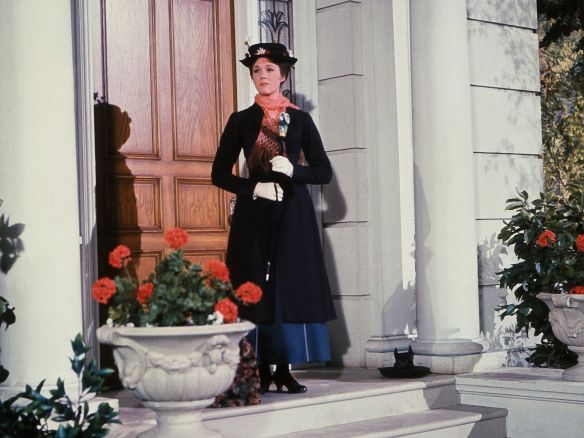
Essential Film Musicals: Mary Poppins

Julie Andrews

Walt Disney’s daughters fell in love with the Mary Poppins books and made him promise to make a film based on them. He first attempted to purchase the film rights from author P.L. Travers as early as 1938. However, she didn’t believe any film could do justice to her books. For more than two decades, Disney tried to convince Travers to allow him to make a Poppins film. He finally succeeded in 1961.

The screenplay by Bill Walsh and Don DaGradi is primarily based on the first novel in the Mary Poppins series, with songs by Robert and Richard Sherman, who suggested the setting be changed from the 1930s to the Edwardian era of the 1910s. Pre-production took about two years, with Travers as adviser. She was very protective of her work and fought the addition of animation and the mellowing of Mary Poppins’ character. She also thought the soundtrack should feature Edwardian songs, not new ones. Disney overruled her on most counts. Travers had script approval, but Disney had final approval.

Julie Andrews won the title role (her film debut) soon after she lost the role of Eliza Doolittle (a role she created on Broadway) to Audrey Hepburn in the film adaptation of My Fair Lady. Disney cast Dick Van Dyke after seeing his work on The Dick Van Dyke Show. Though Van Dyke’s performance is fondly remembered, his accent is regarded as one of the worst in film history. When he received BAFTA’s honorary Britannia Award, Van Dyke told the British audience, “I appreciate this opportunity to apologize to the members of BAFTA for inflicting on them the most atrocious Cockney accent in the history of cinema” (watch here).

Filming took place between May and September 1963, shot entirely at the Walt Disney Studios in Burbank, Calif., using painted London background scenes. Post-production and animation took another 11 months, and the film premiered at Grauman’s Chinese Theatre in Hollywood on August 27, 1964. Travers was not extended an invitation to the opening gala but managed to obtain a ticket from a studio executive. At the after-party, she reportedly told Disney that the animated sequence had to go, and Disney simply responded, “Pamela, the ship has sailed.”

The film received universal critical acclaim and was nominated for 13 Academy Awards, including picture (Disney’s first in this category), winning five: actress (Andrews), editing, score, visual effects, and song (“Chim Chim Cher-ee”) (watch here). However, Travers remained unhappy with the adaptation and refused all other adaptations her other novels.

When British theater producer Cameron Mackintosh approached Travers about a stage musical in the 1990s, she agreed on the conditions that he use only English-born writers and that no one from the film production be directly involved. The musical eventually opened on London’s West End in 2004, eight years after Travers had died.

In 2006, the American Film Institute ranked the movie #6 on its list of best film musicals, and in 2013, it was selected for preservation in the Library of Congress National Film Registry.

With approval from the Travers estate, Disney did produce a sequel, Mary Poppins Returns in 2018, based on the remaining seven books in the series. It starred Emily Blunt and Lin-Manuel Miranda, directed by Rob Marshall, with 1964 film cast members Dick Van Dyke and Karen Dotrice in cameo roles.

Listen to the Grammy-winning, chart-topping soundtrack, then watch the film, available in various formats from Disney and streaming on Disney+. For more about the making of the film, read Mary Poppins: Anything Can Happen If You Let It (2007) by Brian Sibley and Michael Lassell or watch Saving Mr. Banks (2013).

NEXT, explore a contemporary British animated film, Yellow Submarine (1968), whose score was inspired by the chart-topping title song by The Beatles (watch here). Even as Julie Andrews led a wave of box-office smashes, from Mary Poppins to The Sound of Music, a cultural shift was underway, and The Beatles were at the forefront of that wave.

THEN, look for The Muppet Movie (1979), the “creation story” of The Muppets with a score by Paul Williams and Kenneth Ascher, including the Oscar-nominated opening song “Rainbow Connection” (watch here).

Posted in History | Tagged , , , , , , , , , , , | Leave a comment

Essential Film Musicals: A Star Is Born

Judy Garland

In 1950, MGM fired Judy Garland. A year later, Vicente Minnelli and she divorced. At a professional and personal nadir, her personal manager (and eventual third husband) Sid Luft engineered a comeback with concerts at the London Palladium and New York Palace theaters. Their success led him to believe that Garland could return to film an even bigger star, and he thought the perfect vehicle was a musical remake of the 1937 film A Star Is Born. Garland had appeared in a 1942 Lux Radio Theater broadcast of the story (listen here) opposite Walter Pidgeon and had even pitched a musical remake to MGM’s Louis B. Mayer, who turned down the idea because he felt her fans would never accept her as the wife of an alcoholic.

Luft teamed with Edward L. Alperson, who had rights to the 1937 film, and they sold Warner Brothers on the idea. George Cukor was eager to direct, but finding Garland’s costar was difficult. Laurence Olivier, Richard Burton, and Tyrone Power were on a long list of leading men considered. Cukor avidly courted Cary Grant, but when he turned down the role, Luft asked James Mason, who agreed. To complete the team, Harold Arlen and Ira Gershwin were hired to write the songs and Moss Hart to adapt the script, and filming began on October 12, 1953.

Cukor dealt not only with constant script changes from Hart but also an unstable leading lady in Garland. Then eight days into production, studio executives decided to switch from filming in WarnerScope, which they felt wasn’t right for the intimate story, and arranged with Twentieth Century-Fox to use CinemaScope, which meant that considerable footage was to be scrapped and filmed again — at a cost of $300,000. These delays and Cukor’s perfectionism stretched the shooting schedule from three months to nearly seven and the budget from $2 million to $5 million.

Principal photography was completed on February 13, and the final sequence (the “Born in a Trunk” medley) was filmed on July 28. The first test screening in August ran 196 minutes, and despite positive feedback from the audience, Cukor trimmed it to 182 minutes. Widely marketed as Garland’s triumphant return to the screen, the picture was given the largest opening gala that Hollywood had seen in years. On Sep. 29, 1954, spotlights swirled over the Pantages Theatre, and more than 20,000 fans jammed the sidewalks, covered live for the first time on television from coast to coast.

Life called it “a brilliantly staged, scored, and photographed film, worth all the effort,” and New York Times critic Bosley Crowther wrote the film was “one of the grandest heartbreak dramas that has drenched the screen in years.” Time wrote that Garland “gives what is just about the greatest one-woman show in modern movie history,” and Newsweek said the film is “a thrilling personal triumph for Judy Garland.”

Despite the acclaim, Warner executives were concerned the running time would limit the number of daily showings, so they made another round of cuts — without Cukor. At its final running time of 154 minutes, the film lost crucial dramatic scenes in the development of the relationship between the leading couple and the musical numbers “Lose That Long Face” (watch here) and “Here’s What I’m Here For” (watch here). Cukor and Garland were unhappy with the choices. The film earned six Oscar nominations, including actor (Mason) and actress (Garland), but won none.

In 1982, film preservationist Ronald Haver found some missing scenes in the Warner film vaults, including the two cut songs, and a 176-minute version was released, with the missing footage reconstructed using pan and scan of production stills. In 1984, more discoveries were made, and another restored version was issued. Afterward, yet another small piece of footage was found: “When My Sugar Walks Down the Street” (watch here) from the “Born in a Trunk” sequence.

The film was selected for preservation in the Library of Congress National Film Registry in 2000 and ranked #7 on AFI’s list of greatest musicals, while the song “The Man That Got Away” (watch here) ranked #11 among AFI’s top songs.

There have been two more adaptations of the 1937 story: in 1976 starring Barbra Streisand and Kris Kristofferson, and in 2018 starring Lady Gaga and Bradley Cooper.

Listen to the soundtrack, then rent or purchase the film through Amazon Prime. TCM regularly broadcasts the film, and it will next on July 12 at 4:45 p.m. ET. For more about the making of the 1952 film, read Ronald Haver’s A Star Is Born: The Making of the 1954 Movie and Its 1983 Restoration (1988).

NEXT, look for Jailhouse Rock (1957), starring Elvis Presley as a construction worker who learns music from his prison cellmate (Mickey Shaughnessy), then becomes a chart-topping star (and selfish lout) after he’s released. The title song (watch here) by Jerry Leiber and Mike Stoller is often cited as Presley’s greatest onscreen moment. Most of the soundtrack was released on a rare EP.

THEN, explore New York, New York (1977), the one musical directed by Martin Scorsese, about the marriage and divorce of a jazz saxophonist (Robert De Niro) and a pop singer (Liza Minnelli), who both achieve fame with the same song, “New York, New York” (watch here), the highlight of the score written by John Kander and Fred Ebb.

Posted in History | Tagged , , , , , , , , , , | Leave a comment

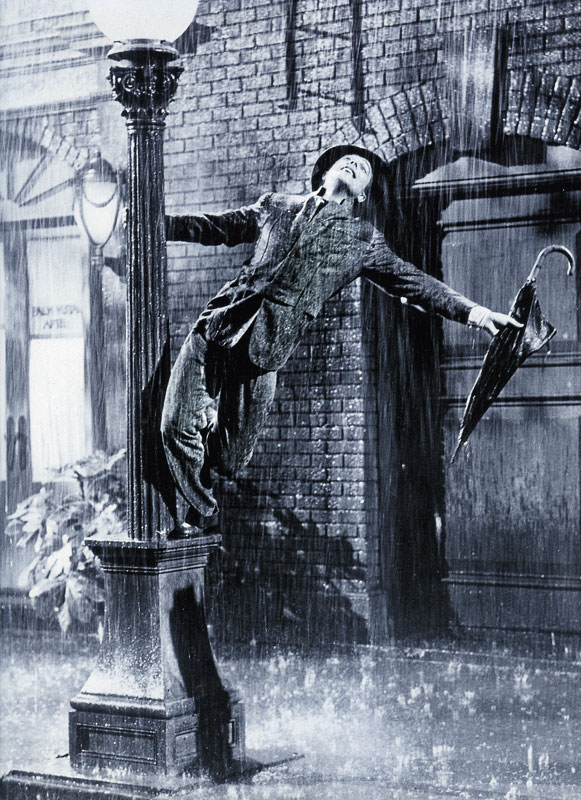
Essential Film Musicals: Singin’ in the Rain

Gene Kelly

Though now often regarded as the greatest film musical ever made, Singin’ in the Rain was only a modest hit when it was first released in 1952. Its stature has grown to near legendary status in the years since. Roger Ebert has even called it “a transcendent experience, and no one who loves movies can afford to miss it.”

As with An American in Paris, producer Arthur Freed conceived of this film as a vehicle for songs of the 1930s. This time, though, it was the songs he himself wrote with Nacio Herb Brown. He hired Broadway writers Betty Comden and Adolph Green to create the story. Since the songs were from the time when silent films were giving way to talking pictures, Comden and Green decided to make the story about that pivotal era in Hollywood, devising three possible openings: a silent movie premiere, a magazine interview, and a star-meets-girl sequence. Comden’s husband Steve suggested that they combine all three, and they did.

Once shooting on An American in Paris was complete, Freed gave the script to Gene Kelly, who enthusiastically signed on to direct and choreograph (with Stanley Donen) and to star as Don Lockwood. Debbie Reynolds (Kathy), Donald O’Connor (Cosmo), and Jean Hagen (Lina) were signed to co-star as the other Hollywood performers caught in the transition from silents to talkies. It was a time that Comden and Green knew well, and they based many supporting roles on real people of that bygone age, including director Roscoe Dexter (on Busby Berkeley) and producer R.F. Simpson (on Freed himself).

In his autobiography, Donen noted that the original scripted ending even included a scene of the premiere for Lina’s newest film, Jungle Princess, in which she “doesn’t say a word — just grunts.” Many production elements from MGM films of the era were also repurposed for this production, including Flesh and the Devil (for Don’s mansion) and Marie Antoinette (for costumes and wigs in The Dueling Cavalier).

The film opened April 11, 1952, to respectable reviews. New York Times critic Bosley Crowther wrote, “All elements in this rainbow program are carefully contrived,” while Washington Post critic Richard L. Coe called it “another fresh and breezy, colorful and funny musical.”

The real cheerleader of the film, though, was New Yorker critic Pauline Kael, who wrote, “This exuberant and malicious satire of Hollywood in the late twenties is perhaps the most enjoyable of movie musicals — just about the best Hollywood musical of all time.” Still, it only received two Oscar nominations, including supporting actress (Hagen), and won neither.

Adaptations include Sam Burlockoff’s graphic version in Eastern Color’s Movie Love #14 (April 1952) and a 1985 stage musical, directed and choreographed by Twyla Tharp. That Broadway production starred Don Correia (Don), Mary D’Arcy (Kathy), Peter Slutsker (Cosmo), and Faye Grant (Lina) and received Tony nominations for book (Comden & Green) and actor (Correia), but won neither.

In 1989, Singin’ in the Rain was among the inaugural class chosen for preservation in the Library of Congress National Film Registry. In the 1998 American Film Institute list of best American movies, it ranked #10; in AFI’s updated 2007 poll, it ranked #5. The 2004 AFI list of top 100 movie songs included three numbers from the film: “Singin’ in the Rain” (#3) (watch here), “Make ’Em Laugh” (#49) (watch here), and “Good Morning” (#72) (watch here). In 2005, the British Film Institute named Singin’ in the Rain one of 50 films to be seen by age 14, and in Sight & Sound’s 2012 list of greatest world films, it ranked #20.

Listen to the soundtrack, then rent or purchase the film through Amazon Prime. TCM regularly broadcasts the film, and it will next on July 19 at noon. For more on the making of the movie, read the 1992 BFI Film Classics book on Singin’ in the Rain by Peter Wollen or Singin’ in the Rain: The Making of an American Masterpiece (2009) by Earl J. Hess and Pratibha A. Dabholkar.

NEXT, look for another Freed Unit classic: The Band Wagon (1953), starring Fred Astaire and Cyd Charisse, with a screenplay by Comden and Green, directed by Vincente Minnelli. The highlight of the score, by Arthur Schwartz and Howard Dietz, is “That’s Entertainment” (watch here).

THEN, explore Gigi (1958), the final great achievement of the Freed Unit, with a screenplay by Alan Jay Lerner, directed by Vincente Minnelli. The film, which stars Leslie Caron in the title role, won all nine Oscars for which it was nominated, including picture and song, “Gigi” (watch here), by Lerner and Frederick Loewe.

Posted in History | Tagged , , , , , , , , , , , , , , , , , | Leave a comment

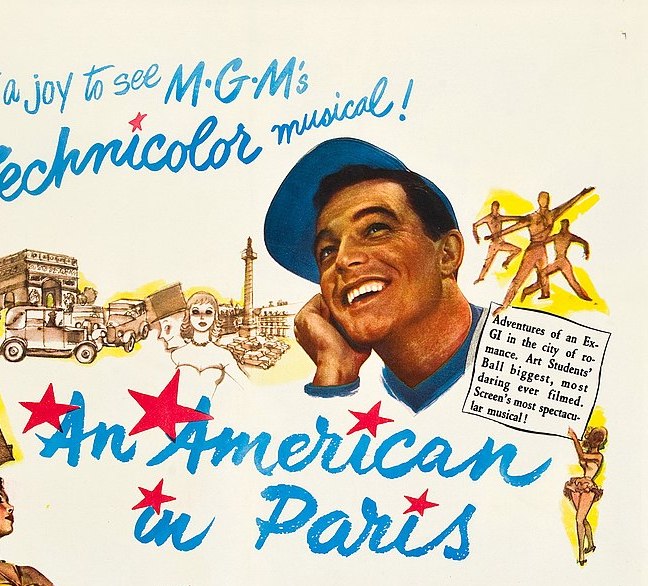
Essential Film Musicals: An American in Paris

MGM’s Freed Unit, which began creating musical films in 1939 under producer Arthur Freed’s leadership, reached the peak of its creative and critical acclaim in 1951 with An American in Paris, which won the Oscar for Best Picture. Much of the film’s fame rests on the 17-minute ballet finale featuring Leslie Caron and Gene Kelly, who received an honorary Oscar “specifically for his brilliant achievements in the art of choreography on film,” inspired by the 1928 orchestral composition by composer George Gershwin.

In 1949, lyricist Ira Gershwin had sold producer Freed rights to the Gershwin Brothers musical catalog, which included such standards as “I Got Rhythm,” “Love Is Here to Stay,” “I’ll Build a Stairway to Paradise,” and “’S Wonderful.” Freed hired Alan Jay Lerner to write a screenplay that used as many of those songs as possible and asked Ira to consider writing new lyrics for “certain unpublished George Gershwin music.” Lerner submitted his first draft on June 12, 1950, which is much the same as the final shooting script. Ira did not submit new songs.

The story centers around Jerry (Kelly), who has moved to Paris after WW2 to find fame as a painter. Very soon he meets Lise (Leslie Caron), whom Henri (Georges Guétary) has been dating. Milo (Nina Foch) takes an interest in Jerry’s art and in him, but he is smitten with Lise, who decides to marry Henri. As Lise and Henri leave for their wedding, Jerry daydreams about dancing around the city with Lise, to the tune of “An American in Paris.” He is woken from his reverie to find that Lise has returned to him. They embrace as the song (and film) ends.

The “American in Paris” dream ballet finale cost nearly half a million dollars and was filmed on 44 sets. Kelly and director Vicente Minnelli had submitted the final outline of their idea to Freed on Sep. 6, 1950: “Each individual scene will be done in the styles of different painters,” they wrote. “In essence, the entire ballet is a representation of a painter thinking about Paris.” The painters chosen were Dufy, Renoir, Utrillo, Rousseau, van Gogh, and Toulouse-Lautrec.

Most of the elaborate film was shot on MGM’s Culver City lot, but some location filming was done in Paris. However, the only Parisian footage used was the opening montage, some establishing shots of French landmarks, a tracking shot of Milo driving to her hotel, and a few atmospheric backgrounds.

The gala premiere was held in Los Angeles on Nov. 9, 1951, and the film opened to excellent reviews, earning $7 million its initial theatrical release. New York Times critic Bosley Crowther gave a mostly positive review, largely on the strength of the ballet, which he called “one of the finest ever put upon the screen.” Variety thought it was “one of the most imaginative musical confections turned out by Hollywood in years,” and Washington Post critic Richard L. Coe called it “the best musical movie I’ve ever seen.”

The film received eight Oscar nominations and won six, including picture (Freed), screenplay (Lerner), art direction, cinematography, costume design, and scoring.

In 1993, it was selected for preservation in Library of Congress National Film Registry, and it ranked #9 on AFI’s Greatest Movie Musicals list. The song “I Got Rhythm” (watch here) ranked #32 on AFI’s 100 Songs list.

In 2014, a stage adaptation premiered in Paris, starring Robert Fairchild (Jerry) and Leanne Cope (Lise), with a script by Craig Lucas directed and choreographed by Christopher Wheeldon. It transferred to Broadway in 2015.

Listen to the soundtrack, then rent or purchase the film through Amazon Prime. TCM regularly broadcasts the film, and it will next on July 4 at 6 a.m. ET. For more on the making of the film, read the 2015 BFI Film Classics book on An American in Paris by Sue Harris.

NEXT, explore Funny Face (1957), which centers around a photographer (Fred Astaire) who falls for model Jo (Audrey Hepburn) in Paris, underscored by Gershwin songs. It’s Astaire’s American in Paris, featuring several Freed Unit members from MGM on loan to Paramount, including Roger Edens, Stanley Donen, Kay Thompson, and Astaire himself. The highlight is the final song, “’S Wonderful” (watch here).

THEN, look for Summer Stock (1950), another Freed Unit musical film with Kelly and Judy Garland, her final film for MGM. TCM will broadcast the film next on June 10 at 10 a.m. ET. The film’s most famous scene is the iconic closing number “Get Happy” (watch here) by Harold Arlen and Ted Koehler, sung by Garland in a tuxedo jacket, fedora, and nylons.

Posted in History | Tagged , , , , , , , , , , , , , | Leave a comment

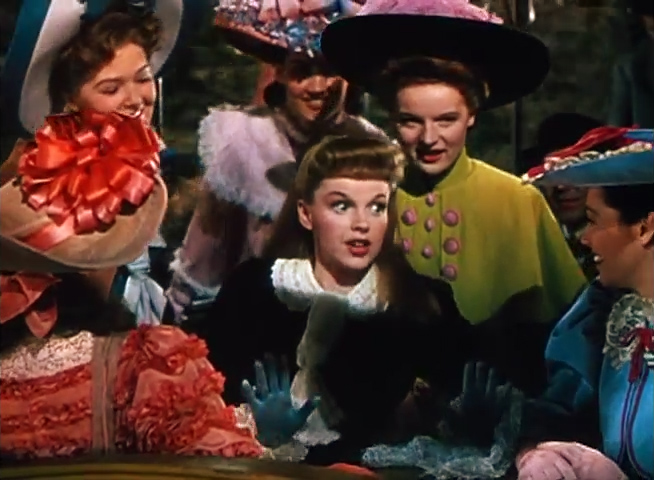
Essential Film Musicals: Meet Me in St. Louis

Garland singing "The Trolley Song"

After working as an uncredited associate producer on The Wizard of Oz, Arthur Freed was given charge of his own unit at MGM. His first effort was the film adaptation of Rodgers and Hart’s stage musical Babes in Arms (1939), starring Mickey Rooney and Judy Garland, which was so successful that it led to a series of backstage musicals with the duo. Over the next two decades, Freed brought scores of Broadway writers, directors, and performers to MGM, helping to secure its status as the leading producer of film musicals.

Another early success for Freed was Meet Me in St. Louis, adapted from Sally Benson’s semi-autobiographical stories about the Smith family in St. Louis at the turn of the 20th century. Benson collaborated with Doris Gilbert on a screenplay treatment, but MGM eventually hired Irving Brecher and Fred Finklehoffe, who delivered a draft on May 22, 1943. The screenplay is divided into four segments, one for each season — as opposed to the 12 stories, one for each month, in Benson’s book.

Freed hired Broadway veterans Vincente Minnelli to direct and Hugh Martin and Ralph Blane to compose the songs, and rehearsals began November 11, with a budget at $1.5 million and a shooting schedule of 58 days. After pre-recording the songs, principle photography began December 7 with Leon Ames (Mr. Smith), Mary Astor (Mrs. Smith), Judy Garland (Esther), Margaret O’Brien (Tootie), and Tom Drake (John, the boy next door).

Having just turned 21, Garland was not happy to portray another teenage girl, and she missed about three weeks of shooting. Initially, this was mainly due to her lack of interest, but Garland’s health soon began to show signs of years of overwork, malnutrition, and medication. The production was further delayed by O’Brien’s unscheduled absences and Joan Carroll’s emergency appendectomy. Filming finally wrapped April 7, 1944, nearly two weeks over schedule.

The film had its official premiere in St. Louis on November 22. It was a commercial and critical success, earning $6.5 million worldwide and receiving four Oscar nominations: adapted screenplay, color cinematography, scoring, and song (“The Trolley Song”). O’Brien won an honorary juvenile Oscar for her work, but the film didn’t collect any competitive awards. In December, Garland had three recordings from the film in the Top 40: “The Trolley Song” (#4), “Meet Me in St. Louis, Louis” (#22), and “Have Yourself a Merry Little Christmas” (#27).

In 1946, Garland and O’Brien reprised their roles in a Lux Radio Theater adaptation (listen here) for CBS, and in 1947 Garland joined the Armed Forces Radio Show for its version of Meet Me in St. Louis. A 1959 TV adaptation starred Walter Pidgeon (Mr. Smith), Myrna Loy (Mrs. Smith), Jane Powell (Esther), Patty Duke (Tootie), and Tab Hunter (John), directed by George Schaefer from the original screenplay. The stage adaptation premiered on Broadway in 1989, with additional Martin and Blane songs and a book by Hugh Wheeler, starring George Hearn (Mr. Smith), Charlotte Moore (Mrs. Smith), Donna Kane (Esther), Courtney Peldon (Tootie), and Jason Workman (John). It received Tony nominations for musical, book, and score, but failed to win any.

In 1994, the film was selected for preservation in the Library of Congress National Film Registry, and it ranked #10 on AFI’s list of Greatest Movie Musicals, while two of its numbers made AFI’s list of 100 Songs: “The Trolley Song” (#26) (watch here) and “Have Yourself a Merry Little Christmas” (#76) (watch here).

Listen to the soundtrack, then rent or purchase the film through Amazon Prime. TCM regularly broadcasts the film, and it will next on June 6 at 6pm ET. For more on the making of the film, read 1994 BFI Film Classics book on Meet Me in St. Louis by Gerald Kaufman.

NEXT, explore Cover Girl (1944), which features Rita Hayworth at the peak of her career. With this film, she became the first woman to dance onscreen with both Fred Astaire and Gene Kelly, for whom the film was a breakthrough. The highlight of the score is the Oscar-nominated “Long Ago (and Far Away)” (watch here) by Jerome Kern and Ira Gershwin.

THEN, look for Easter Parade (1948), with an Irving Berlin score, in which Garland costars with Fred Astaire for the first time — making her the second woman to dance onscreen with both Astaire and Kelly. Arthur Freed had coaxed Astaire out of semi-retirement to replace Kelly, who broke his ankle playing volleyball just before filming was to begin. TCM regularly broadcasts the film, and it will next on June 10 at 4pm ET.

Posted in History | Tagged , , , , , , , , , , , , | Leave a comment

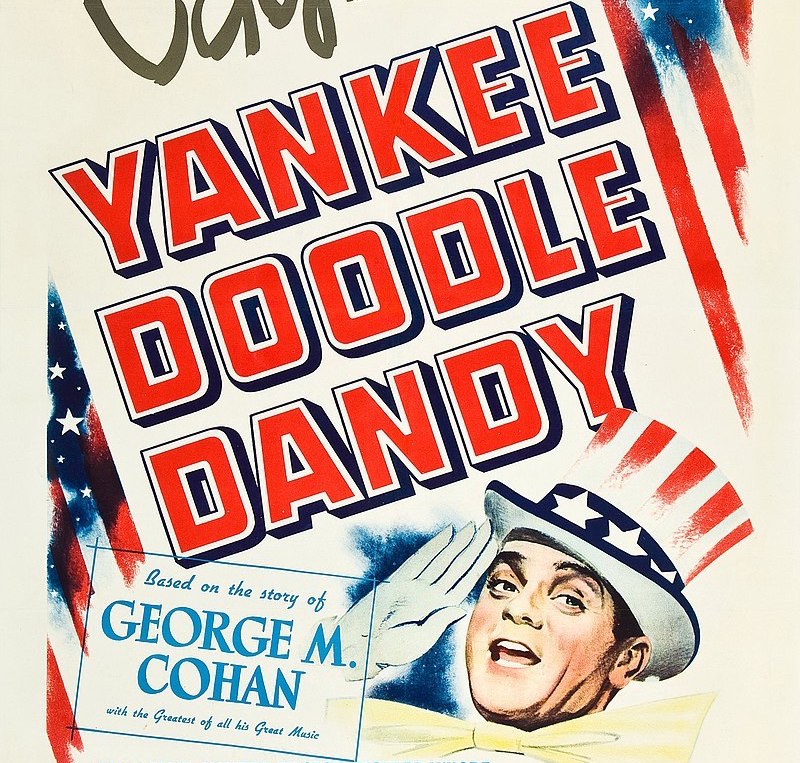
Essential Film Musicals: Yankee Doodle Dandy

“There’s little that’s really original,” Roger Ebert has said of the musical biopic Yankee Doodle Dandy. “The greatness of the film resides entirely in the Cagney performance.” In its 1942 review, Variety similarly noted, “James Cagney does a Cohan of which the original George M. might well be proud.” Indeed, after seeing the film, Cohan’s first response was, “My God, what an act to follow!”

James Cagney was best known for his 1930s gangster roles in film, but he began his career in vaudeville as a dancer and comedian. He had disliked Cohan since 1919, when Cohan sided against an Actors’ Equity strike, but Cagney took the role partly because he believed that starring in such a patriotic film would deflect recent political criticism about him. In 1940, Cagney had been among 15 Hollywood figures named in John R. Leech’s testimony before the HUAC.

The film, written by Robert Buckner and Edmund Joseph (with uncredited work by Julius and Philip Epstein), is presented as an implausible flashback. Cohan is summoned to the White House to receive a congressional medal, and FDR recalls seeing him perform some 40 years earlier. “I was a pretty cocky kid in those days,” Cohan says, then starts narrating his life story for the president.

Cohan objected to the liberties taken with some facts, specifically the creation of the character Mary (played by Joan Leslie), a composite of his two wives (Ethel and Agnes). Producer Hal B. Wallis dismissed Cohan’s concerns by replying, “The deep-dyed Americanism of your life is a much greater theme.” Ethel later sued for violation of her “rights of privacy,” but Judge William Bondy ruled, “The introduction of fictional characters and a large fictional treatment of Cohan’s life may hurt Miss Levey’s feelings but they do not violate her rights of privacy.”

The sets, costumes, and dance routines, though, are faithful to the originals and provide a glimpse of the American musical theater at the turn of the 20th century. Cagney’s performance is directly styled after Cohan’s unique mannerisms, supervised by dance instructor John “Jack” Boyle, who had performed in The Cohan Revue of 1916, and by technical advisor William Collier, who had costarred with Cohan in the 1914 revue Hello, Broadway.

Cohan was also a consultant on the film, but his failing health only allowed limited involvement. His contract also stipulated he compose three new songs, but he was too ill to write them. In fact, the studio worked to complete production before Cohan died, moving up the New York gala opening from July 4 to May 29.

In line with the film’s patriotic theme, Warner sold tickets for the premiere only to those who had bought war bonds from $25 to $25,000, which raised more than $5 million for the war effort. Reviews the next day were excellent. New York Times critic Bosley Crowther thought it “as affectionate, if not as accurate, a film biography as has ever — yes, ever — been made,” and Harrison’s Reports called it “one of the most sparkling and delightful musical pictures that have ever been brought to the screen.” Cohan died six months later.

The movie was one of Film Daily’s Top 10 of 1943 and received eight Oscar nominations, including picture, director (Michael Curtiz), original story (Buckner), actor (Cagney), supporting actor (Walter Huston), editing (George Amy), sound recording (Nathan Levinson), and scoring (Ray Heindorf and Heinz Roemheld). It picked up wins for Cagney, the first for a leading musical role, as well as sound and score. Cagney recreated his role for a scene in the 1955 film The Seven Little Foys. In 1993, Yankee Doodle Dandy was selected for preservation in the Library of Congress National Film Registry.

There was a 1942 half-hour CBS radio adaptation for the Screen Guild Players, with original stars Cagney, Leslie, and Huston. The film hasn’t had a stage adaptation, but the 1968 musical George M! (by Michael Stewart and John & Francine Pascal) and 2004 musical Yankee Doodle Dandy! (by David Armstrong and Albert Evans) both use Cohan’s music to tell his life story.

Listen to the soundtrack, then rent or purchase the film through Amazon Prime. TCM also regularly broadcasts the film on July 4 and will again this year. For more about the making of the film, read the 1981 Wisconsin Press edition of the screenplay, edited by Patrick McGilligan.

NEXT, explore the musical biopic Stormy Weather (1943), loosely based on the life of its star, Bill “Bojangles” Robinson. Among the 20 (yes, 20) musical numbers in the film’s 80 minutes (yes, only 80) are “Jumpin’ Jive” (with Cab Calloway and the Nicholas Brothers), “Ain’t Misbehavin’” (with Fats Waller), and the classic title song by Harold Arlen and Ted Koehler (with Lena Horne and Katherine Dunham).

THEN, look for Seven Brides for Seven Brothers (1954), music by Saul Chaplin and Gene de Paul with lyrics by Johnny Mercer, set in the 19th century Oregon Territory. Its barn-raising sequence is among the best dance sequences ever filmed.

Posted in History | Tagged , , , , , , , , , , , | Leave a comment

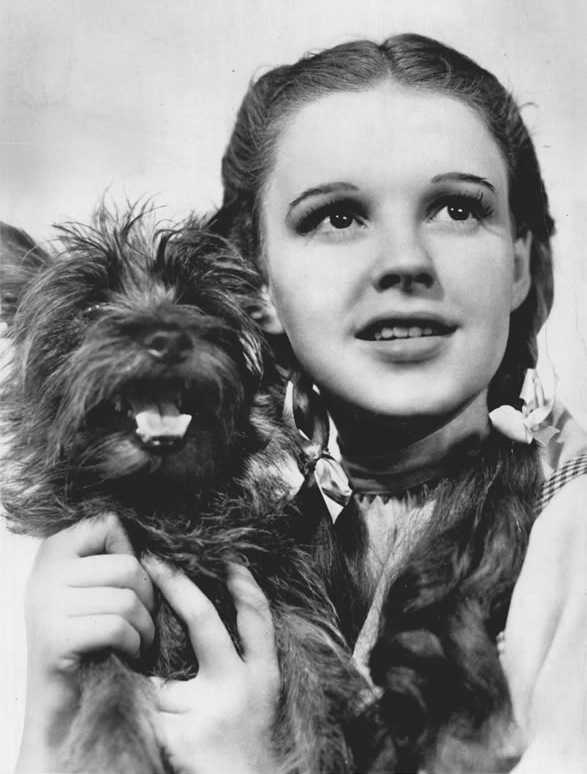
Essential Film Musicals: The Wizard of Oz

Terry and Garland in "The Wizard of Oz" (1939)

After Disney’s Snow White showed that children’s stories could be profitable, MGM bought the rights to L. Frank Baum’s 1900 novel The Wonderful Wizard of Oz, about the adventures of Kansas farm girl Dorothy and her dog Toto in the magical land of Oz. The book had been adapted as a 1902 stage musical and three silent films, but MGM’s version is the best-known, considered one of the greatest films and a cultural icon.

Directed primarily by Victor Fleming, with songs by Harold Arlen and Yip Harburg, the 1939 film The Wizard of Oz stars Judy Garland (Dorothy), Ray Bolger (Scarecrow), Jack Haley (Tin Man), Bert Lahr (Cowardly Lion), Billie Burke (Glinda), Margaret Hamilton (Wicked Witch), Frank Morgan (Wizard) — and Terry (Toto).

The screenplay is among the most quoted in pop culture. Noel Langley, Florence Ryerson, and Edgar Allan Woolf are credited as the writers, but the script went through several hands. Producer Mervyn LeRoy hired Langley, Herman J. Mankiewicz, and Ogden Nash to write separate versions. Ryerson and Woolf were asked to compile the final script. However, associate producer Arthur Freed was unhappy with their work and reassigned it to Langley. During filming, Fleming and screenwriter John Lee Mahin made further revisions, and the final draft was delivered October 8, 1938.

The major change from the book is that Oz is an elaborate dream and not a true fantasy world. Another notable change is Dorothy’s shoes. In the book, they were silver, but Adrian (MGM’s chief costume designer) chose ruby to take advantage of the new Technicolor process used on the film.

Several changes in casting were also made before filming began. Bolger was originally to be the Tin Man and Buddy Ebsen the Scarecrow, but Bolger asked LeRoy to switch, and Gale Sondergaard was the original Wicked Witch but became unhappy when the character went from glamorously evil (like Snow White’s Queen) to clichéd hag. MGM contract player Margaret Hamilton replaced her three days before production began.

Filming started October 13 at the MGM lot in Culver City, with Richard Thorpe as director, replacing Norman Taurog, who had only shot a few Technicolor tests. Nine days later, LeRoy shut down production to find another director and filming resumed November 3, with Victor Fleming at the helm.

Production was again interrupted ten days into the shoot, when Ebsen suffered a reaction to the aluminum powder in his makeup and left the film, replaced by Jack Haley. Another incident involved a concealed elevator that lowered Hamilton below the soundstage as fire and smoke erupted to dramatize (and conceal) her exit from Munchkinland. On the second take, the burst of fire came too soon and ignited her copper-based makeup, causing third-degree burns on her hands and face. It was three months before she returned.

Then on February 12, 1939, Fleming was called away to replace George Cukor on Gone with the Wind. The next day, King Vidor was on set to finish principal photography (including the “Over the Rainbow” sequence), which ended March 16. Reshoots and pick-up shots were led by LeRoy, and test screenings began June 5, which led to about 15 minutes of cuts. “Over the Rainbow” was nearly one. MGM execs felt it made the Kansas sequence too long, but LeRoy, Freed, and Fleming fought to keep it in.

The New York premiere was followed by a live performance from Garland and Mickey Rooney, who did so after each screening for the next three weeks, with Bolger and Lahr replacing Rooney for the final week. The film opened nationwide on August 25 and was met with widespread acclaim. Film Daily wrote, “Seldom if indeed ever has the screen been so successful in its approach to fantasy and extravaganza,” and the movie placed #7 on its year-end Top 10.

The film received six Oscar nominations, including best picture, winning for Herbert Stothart’s score and Arlen and Harburg’s song “Over the Rainbow.” Garland also won an honorary award for her performance. Despite the film’s success, MGM only broke even on its $3 million investment, the studio’s most expensive production at the time, not earning a profit until the 1949 re-release.

In 1956, CBS was first to broadcast the film, beginning an annual tradition. In 1989, The Wizard of Oz was in the inaugural class of the Library of Congress National Film Registry. It ranked #6 on American Film Institute’s 1998 list of 100 movies, while “Over the Rainbow” was #1 on AFI’s 2004 list of 100 songs and #1 on RIAA’s Songs of the Century. AFI’s 2005 list of 100 quotes included three from the film: Dorothy’s “Toto, I’ve a feeling we’re not in Kansas anymore” (#4) and “There’s no place like home” (#23) and the Wicked Witch’s “I’ll get you, my pretty — and your little dog, too!” (#99).

There was an official 1972 sequel, the animated Journey Back to Oz starring Garland’s daughter Liza Minnelli, and a 1975 MGM comic book adaptation, Marvelous Wizard of Oz, but the “great and powerful Oz” remains the 1939 classic.

Listen to the soundtrack, then rent or purchase the film through Amazon Prime. There is a cottage industry of information about the making of the movie, but one of the best is The Wizardry of Oz (2004) by Jay Scarfone and William Stillman.

NEXT, explore the next phase of Garland’s career with Girl Crazy (1943), the last and best of the Mickey & Judy “let’s put on a show” musical films, featuring songs by George and Ira Gershwin, including the lavish “I Got Rhythm” directed by Busby Berkeley. Listen to the soundtrack, then rent or purchase the film through Amazon Prime.

THEN, look for Holiday Inn (1942), featuring Irving Berlin’s Oscar-winning “White Christmas,” sung by Bing Crosby, which became the world’s best-selling single and ranked #2 on RIAA’s Songs of the Century. Listen to the soundtrack, then rent or purchase the film through Amazon Prime.

Posted in History | Tagged , , , , , , , , , , , , | Leave a comment

Essential Film Musicals: Top Hat

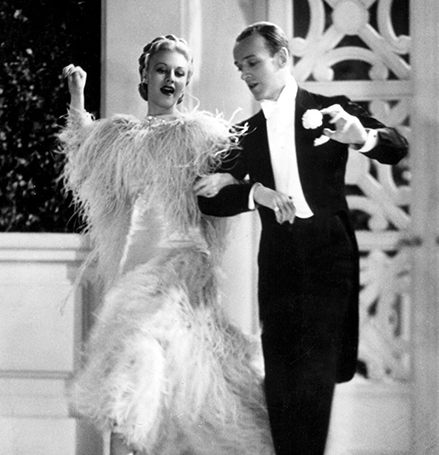
Rogers and Astaire dancing "Cheek to Cheek"

“When Hollywood revived musical films three years ago, dancing was monopolized by director Busby Berkeley,” Newsweek magazine noted in its 1935 review of Top Hat. “Thanks more to Fred Astaire than any other single influence, the character of musicomedy in the cinema has now completely changed.” And changed for the better in most estimates. “The dancing on the screen reaches such perfection as is attainable,” critic Roger Ebert wrote about Astaire and partner Ginger Rogers. “To watch them is to see hard work elevated to effortless joy.” Top Hat not only became the most successful Astaire and Rogers film but also the team’s most iconic.

Director Mark Sandrich started work on the production in December 1934, as Astaire began five weeks of rehearsal on a closed set — just himself, choreographer Hermes Pan, and pianist Hal Borne, with Rogers called when she was needed. As Borne played, Astaire and Pan would improvise steps until they found a shape that satisfied Astaire.

In January, screenwriter Dwight Taylor sent composer Irving Berlin a rough outline, then a first draft a month later. Astaire complained about the script’s thin plot, its similarity to his previous film The Gay Divorcee, and its unsympathetic view of his character. Sandrich hired Allan Scott to rework the script, and the two screenwriters continued to submit separate versions to the director, who passed them on with notes to Berlin.

In April, a final draft was compiled from Taylor and Scott’s versions and filming began, with a budget between $500,000 and $750,000. Scott and Sandrich continued to rewrite, and a final script wasn’t done until May. Though based on the 1933 German film Scandal in Budapest written by Karl Noti (itself based on the 1930 Hungarian stage comedy A Girl Who Dares by Sándor Faragó and Aladár László), RKO didn’t credit the source material since so little ended up in the final film.

The dances were usually shot in single takes, framed head-to-foot, in one of three camera angles: head-on, medium right angle, and medium left angle. No reaction shots. For “Cheek to Cheek,” Rogers was determined to wear a dress trimmed with ostrich feathers. In his autobiography, Astaire described the difficulties they encountered with those feathers. “When we did the first movement of the dance, feathers started to fly as if a chicken had been attacked by a coyote,” he wrote. “Hermes Pan and I sang a little parody on ‘Cheek to Cheek’ to Ginger. … ‘Feathers, I hate feathers, and I hate them so that I can hardly speak, and I never find the happiness I seek with those chicken feathers dancing cheek to cheek.’” Astaire later parodied the experience in Easter Parade (1948).

Shooting ended in June, and public previews began in July. A Santa Barbara audience gave the picture a cool reception, finding that the ending was too long, so about 15 minutes were trimmed from the carnival sequence and gondola parade.

The film premiered in New York at Radio City Music Hall on August 29, 1935, setting a house record of $134,800 in its first week. Overall, the film earned more than $3 million, RKO’s most profitable production of the decade, and by September, three songs (“Cheek to Cheek,” “Top Hat,” “Isn’t This a Lovely Day”) were in the Top 5 on Your Hit Parade. Berlin gave credit to Astaire as “a real inspiration for a writer. I’d never have written Top Hat without him. He makes you feel so secure.”

Reviews were mainly positive. The New York Times praised the musical numbers, while noting, “If the comedy itself is a little on the thin side, it is sprightly enough to plug those inevitable gaps between the shimmeringly gay dances.” Variety was more critical: “It’s the same lineup of players as was in The Gay Divorcée. Besides which the situations in the two scripts parallel each other closely.” Despite rewrites, critics still found Fred & Ginger’s new film too similar to their last.

Film Daily included the movie in its top 10 list of 1935, and Top Hat received Oscar nominations for picture, art direction, original song (“Cheek to Cheek”), and dance direction (“Piccolino” and “Top Hat”). It lost in all four categories.

In 1990, the film was selected for preservation in the Library of Congress National Film Registry, and in 2006, it ranked #15 on AFI’s list of best movie musicals. A stage adaptation opened on London’s West End in 2012, winning three Olivier Awards, including Best New Musical.

You can listen to the soundtrack on Pandora (paired with Swing Time), and rent or buy Top Hat on Amazon Prime. For more about the making of the film, look for the Wiley-Blackwell studies series on Top Hat (2010) by Peter William Evans.

NEXT, try another Fred & Ginger classic: Swing Time (1936), with songs by Jerome Kern and Dorothy Fields, including the Oscar-winning “The Way You Look Tonight.” Many consider this film their best dancing, if not their best story. You can listen to the soundtrack on Pandora (paired with Top Hat) and stream the film or purchase the DVD through Amazon Prime.

THEN, explore Disney’s second animated musical: Pinocchio (1940), with songs by studio writers Leigh Harline and Ned Washington, including the Oscar-winning “When You Wish upon a Star,” which has become the company’s theme song. The film is available in various video formats from Disney and streaming on Disney+.

Posted in History | Tagged , , , , , , , | Leave a comment

Essential Film Musicals: 42nd Street

In 1927, Warner Brothers launched the era of talkies with The Jazz Singer, and studios scrambled to hire Broadway composers. Within a handful of years, screens were flooded with movie musicals, most of them hastily put through production, and audiences began to shrink. Hollywood released more than 100 “all-talking, all-singing” features in 1930, but only 14 in 1931. Public distaste for musicals became so great that studios even began cutting songs from Broadway adaptations like Cole Porter’s Fifty Million Frenchmen. The film credited with rescuing the movie musical is 42nd Street, particularly its last 20 minutes that showcase three drill-precision, kaleidoscopic dances by Busby Berkeley.

The film is adapted from a 1932 novel of the same name by Bradford Ropes, who had intended to write an “Uncle Tom’s Cabin of the chorus girl,” a story that would shed light on their exploitation and struggle for survival. The film took a different tone, highlighting the show business atmosphere for stagestruck youngsters intoxicated with theater. Whitney Bolton wrote the first treatment and worked with James Seymour on several screenplay drafts before he was replaced by Rian James.

Production began in October 1932, filming for 28 days at all three Warner Brothers facilities (the original Sunset studio, Vitagraph Studio in Hollywood, and old First National sound stages in Burbank), under the direction of Lloyd Bacon, who had replaced the ailing Mervyn LeRoy. The film marked Ruby Keeler’s screen debut and the first Warner feature for choreographer Berkeley and songwriters Harry Warren and Al Dubin. In addition to Keeler (Peggy), the film starred Warner Baxter (Julian), Bebe Daniels (Dorothy), and Dick Powell (Billy) and featured LeRoy’s girlfriend Ginger Rogers (Anytime Annie).

As a publicity stunt, a train called the “42nd Street Special” traveled from Hollywood to New York City for the film’s opening. Onboard were celluloid celebrities such as Joe E. Brown, Bette Davis, and Tom Mix (with his horse). The movie premiered on March 9, 1933, and went into general release two days later, becoming one of the most profitable features of the year, earning an estimated $2.3 million against a production cost of $340,000 to $439,000.

It ranked #2 on The Film Daily’s Ten Best list of 1933 and received Oscar nominations for Best Picture and Best Sound Recording. New York Times critic Mordaunt Hall called it “one of the most tuneful screen musical comedies that has come out of Hollywood,” while John Mosher of The New Yorker thought 42nd Street was “as pretty a little fantasy of Broadway as you may hope to see.” Variety’s review simply said, “It’ll socko the screen musical fans.”

Warner followed the film with a sequel of sorts: Gold Diggers of 1933, with 42nd Street alums LeRoy, Berkeley, Warren and Dubin, Keeler, Powell, and Rogers. Songs from both films provided the score for the 1980 stage adaptation of 42nd Street, produced by David Merrick and choreographed by Gower Champion, with Wanda Richert (Peggy), Jerry Orbach (Julian), Tammy Grimes (Dorothy), and Lee Roy Reams (Billy). The stage adaptation won the 1981 Tony Award for Best Musical and ran for 3,486 performances.

In 1998, the film was selected for preservation in the Library of Congress National Film Registry. In 2006, it ranked #13 on American Film Institute’s list of the Greatest Movie Musicals. On AFI’s 100 Songs, “42nd Street” ranked #97, while the line “Sawyer, you’re going out a youngster, but you’ve got to come back a star!” ranked #87 on AFI’s 100 Movie Quotes.

To hear the score, look for the soundtrack recording from Soundtrack Factory or listen to the original Broadway cast recording. The film is available in Blu-ray, DVD, and digital formats from Warner. For more about the making of the film, read the 1980 Wisconsin Press edition of the screenplay, edited by Rocco Fumento.

NEXT, look for Love Me Tonight (1932), a landmark in musical film editing, with a score by Broadway songwriters Richard Rodgers and Lorenz Hart, starring Maurice Chevalier and Jeanette McDonald. The full soundtrack isn’t available, but “Isn’t It Romantic?” and “Love Me Tonight” are on the album Change Partners. The film is available on DVD from Universal.

THEN, listen to Snow White and the Seven Dwarfs (1937), the first full-length animated musical film, with songs by Disney studio writers Frank Churchill and Larry Morey, including the iconic “Someday My Prince Will Come.” The film is available in various video formats from Disney and streaming on Disney+.

Posted in History | Tagged , , , , , , , | Leave a comment

Essential Musicals: Hamilton

Once in a generation, a musical comes along that resets the theatrical atmosphere and perhaps enters the wider popular culture. Hamilton is such a show — as Show Boat was in the 1920s, Oklahoma! in the 1940s, Hair in the 1960s, Phantom of the Opera in the 1980s, and Rent as the millennium approached. “Whether it’s a watershed, a breakthrough, and a game-changer,” New York magazine critic Jesse Green noted in his review of Hamilton, “Miranda is too savvy (and loves his antecedents too much) to try to reinvent all the rules at once.”

While on vacation from his 2008 Tony-winning musical In the Heights, Lin-Manuel Miranda read Ron Chernow’s 2004 biography of Alexander Hamilton. Within a few chapters, he began to envision music leaping off the pages. He secured Chernow as historical consultant and started work on The Hamilton Mixtape, a show about “America then, as told by America now.” On May 12, 2009, he was invited to perform music from In the Heights at the White House. Instead, he performed a draft of his new show’s opening, “Alexander Hamilton.” (President Obama later invited Miranda back to perform music from Hamilton with the original cast.)

By July 2013, Miranda had a draft of the entire first act and three songs from the second act, which he presented in a workshop at Vassar College, where Thomas Kail joined as director and Alex Lacamoire as musical director. After another two years of writing, the show made its Off-Broadway debut at the Public Theater in February 2015. Choreographer Andy Blankenbuehler joined Kail and Lacamoire for the production, which included three principals from the workshop production: Miranda (Hamilton), Daveed Diggs (Lafayette, Jefferson), and Christopher Jackson (Washington).

Variety critic Marilyn Stasio wrote, “Miranda’s impassioned narrative of one man’s story becomes the collective narrative of a nation, a nation built by immigrants who occasionally need to be reminded where they came from.” New York magazine critic Jesse Green highlighted Miranda’s craft: “The conflict between independence and interdependence is not just the show’s subject but also its method: It brings the complexity of forming a union from disparate constituencies right to your ears.” Stasio had also noted, “The sense, as well as the sound of the sung dialogue, has been purposely suited to each character.”

The production received 12 Lortel Award nominations, winning for musical, director (Kail), choreographer (Blankenbuehler), actor (Miranda), actress (Phillipa Soo), featured actor (Diggs), and featured actress (René Elise Goldsberry). It received additional outstanding musical awards from the Outer Critics Circle, Drama Desk, New York Drama Critics, Off Broadway Alliance, and Obie Awards.

After two extensions of its limited Off-Broadway engagement, it moved to Broadway. Most of the cast moved with the show, except Brian d’Arcy James, replaced as King George III by Jonathan Groff. In his review of the Broadway transfer, Time Out New York critic David Cote wrote, “The work’s human drama and novelistic density remain astonishing.”

The production received a record-setting 16 Tony nominations, winning for musical, book (Miranda), score (Miranda), actor (Leslie Odom Jr.), featured actor (Diggs), featured actress (Goldsberry), direction (Kai), choreography (Blankenbuehler), and orchestrations (Lacamoire). It also received a 2015 Smithsonian American Ingenuity Award, 2016 Pulitzer Prize for Drama, and a special 2018 Kennedy Center Honors.

The West End production opened in December 2017, winning seven Olivier Awards, including musical. The first U.S. national tour began in March 2017, a second tour in February 2018, and a third tour in January 2019, which included a three-week engagement in Puerto Rico with Miranda in the title role.

The cast album peaked at #3 on Billboard 200 and #1 on the Top Rap Albums chart, the first cast album to do so, and won the Grammy as Best Musical Theater Album. It became the fifth best-selling album of 2016 and was certified six-time multiplatinum, making it the best-selling cast recording ever. The followup The Hamilton Mixtape topped the album charts in 2016.

After listening to the original cast album, read more about the making of the show in Hamilton: The Revolution, by Miranda and Jeremy McCarter. Then watch the film, which premieres July 3, 2020, on Disney+.

NEXT, listen to another multi-platinum (and Grammy-winning) cast album: Wicked, with a score by Stephen Schwartz and book by Winnie Holzman, based on Gregory Maguire’s 1995 retelling of the classic story from the perspective of the witches in Oz, before and after Dorothy arrives.

THEN, explore The Book of Mormon by Trey Parker, Robert Lopez, and Matt Stone. It became the fastest-selling cast album in iTunes history and the first to make the Top 10 on Billboard’s album chart since Hair in 1969.

Posted in History | Tagged , , , , , , , , | Leave a comment