2020 OBA Awards

"A Strange Loop"

On April 28, journalist Michael Musto announced the nominees for the 10th annual Off Broadway Alliance Awards, including an honorary award to book writer and lyricist Gretchen Cryer as one of OBA’s Legends of Off Broadway. This morning, Charles Busch and Julie Halston announced the 2020 competitive category winners.

The award for Best New Musical went to A Strange Loop by Michael R. Jackson (book, music, lyrics), which won the Pulitzer Prize for Drama earlier this month. It was presented June 17-July 28, 2019, at Playwrights Horizons. Best Musical Revival honors went to The Unsinkable Molly Brown by Dick Scanlan (book, new lyrics) and Meredith Willson (music, lyrics), which ran Feb.8-26, 2020, at Transport Group.

The award for Best Family Show was given to She Persisted by Adam Tobin (book, lyrics) and Deborah Wicks La Puma (music), adapted from the book by Chelsea Clinton, illustrated by Alexandra Boiger. It was presented Feb. 22-Mar. 12, 2020, at Atlantic Theater Company.

Posted in Awards, Stage | Tagged , , , , , , , , | Leave a comment

Essential Musicals: Sweeney Todd

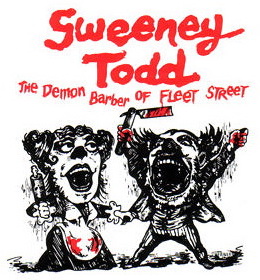
“Attend the tale of Sweeney Todd. He served a dark and a vengeful god.” With that, the title character introduces himself and prepares us for a macabre musical about obsession, revenge — and cannibalism. Composer Stephen Sondheim has called Sweeney Todd a “black operetta,” which could also describe The String of Pearls, the 1846 “penny dreadful” that introduced Todd. Such Victorian stories, serialized in cheap weekly periodicals, told lurid and sensational tales that entertained millions of working class men. In fact, Todd’s tale was so popular that a play adaptation premiered before the ending of the 18-episode novel was published.

However, Hugh Wheeler’s book for the musical isn’t based on that original version but playwright Christopher Bond’s 1973 melodrama, which presents Todd as the victim of a ruthless judge who raped his wife and exiled him to Australia. “It had a weight to it,” Sondheim said. Bond “was able to take all these disparate elements that had been in existence rather dully for a hundred and some-odd years and make them into a first-rate play.”

Sondheim brought the idea to director Harold Prince, who was uninterested until he discovered a metaphor for the show, turning Sondheim’s “small horror piece” into an Industrial Revolution epic. “Hal’s metaphor is that the factory turns out Sweeney Todds. It turns out soulless, defeated, hopeless people. That’s what the play’s about to him. Sweeney Todd is a product of that age,” Sondheim explained. “I think it’s not. Sweeney Todd is a man bent on personal revenge, the way we all are in one way or another, and it has nothing whatsoever to do with the time he lived in, as far as I’m concerned.”

With its massive set (which scenic designer Eugene Lee recreated from a Rhode Island foundry), the show couldn’t afford to travel for out-of-town tryouts, so it started previews on Broadway. “We never finished teching the show before the first preview,” actor Len Cariou recalled, “because the main set piece — the revolve — kept breaking down.” Despite continuing technical difficulties, the show was enthusiastically received when it opened on Broadway in March 1979, starring Cariou (Todd), Angela Lansbury (Mrs. Lovett), and Edmund Lyndeck (Judge Turpin).

“There is more artistic energy, creative personality and plain excitement in Sweeney Todd … than in a dozen average musicals,” New York Times critic Richard Eder wrote. “There is very little in Sweeney Todd that is not, in one way or other, a display of extraordinary talent.” The production was nominated for nine Tony Awards and won eight, including musical, book (Wheeler), score (Sondheim), actor (Cariou), actress (Lansbury), direction (Prince), scenic design (Lee), and costume design (Franne Lee).

Three months after the Broadway production closed, the first national tour began, with George Hearn, Lansbury, and Lyndeck. The tour was taped for TV and nominated for five Emmy Awards in 1985, winning three, including one for Hearn. The London premiere in 1980 starred Denis Quilley, Sheila Hancock, and Austin Kent and won the Olivier Award for Best New Musical. The first opera production was at Houston Grand Opera in 1984, with Timothy Nolen, Joyce Castle, and Will Roy.

There have been several notable productions since then, including the first Broadway revival in 1989, directed by Susan H. Schulman, starring Bob Gunton, Beth Fowler, and David Barron. That production transferred from Off-Broadway, where it had an intimate design that earned it the nickname “Teeny Todd.” In 2004, John Doyle directed a regional British revival that transferred to the West End. That production was also notable for its intimacy: its 10 cast members played the entire show. It subsequently transferred to Broadway in 2005, starring Michael Cerveris, Patti LuPone, and Mark Jacoby and won Tony Awards for its direction and its orchestrations, which Sarah Travis had reduced from the original arrangements.

A feature film, directed by Tim Burton with a screenplay by John Logan, was released in 2007 and won the Golden Globe. It starred Johnny Depp, Helena Bonham Carter, and Alan Rickman. In 2014, the Tooting Arts Club site-specific production at Harrington’s Pie Shop transferred to the West End and then to Off-Broadway, starring Jeremy Secomb, Siobhan McCarthy, and Duncan Smith.

The original Broadway cast recording remains the best interpretation — and even includes Turpin’s haunting “Johanna (Mea Culpa),” which was cut in previews. The album won the Grammy Award for Best Cast Show Album and was selected in 2013 for preservation in the Library of Congress National Recording Registry.

You can learn more about the making of the musical in Sondheim & Co. (1974) by Craig Zadan. For insightful dramaturgy, read Art Isn’t Easy (1990) by Joanne Gordon, who focuses on Sondheim’s lyrics, and Sondheim’s Broadway Musicals (1993) by Stephen Banfield, who focuses on music.

NEXT, explore the musical that Hal Prince led to Broadway just six months after Sweeney Todd had opened: Evita, with a libretto by Tim Rice and music by Andrew Lloyd Webber. Among the two dozen English recordings, the 1976 concept album (Julie Covington, Colm Wilkinson) is worth a listen, but I prefer the 1979 premiere American recording (Patti LuPone, Mandy Patinkin), not the least because it has the entire score.

THEN, for another musical with an industrial-sized setting and scope, listen to Ragtime, by Terrence McNally (book), Lynn Ahrens (lyrics), and Stephen Flaherty (music).
Posted in History | Tagged , , , , , , , , , | Leave a comment

Essential Musicals: A Chorus Line

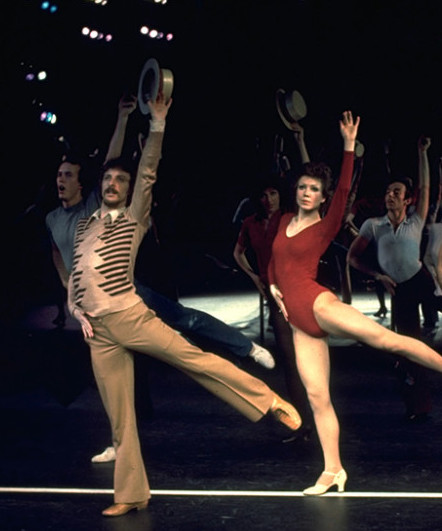
LuPone and McKechnie in "A Chorus Line" (1975)

At an audition, 18 dancers vie for eight openings in the chorus line of an upcoming musical. The director invites them to step forward, one by one, and tell him something true about themselves. And they do.

That’s the simple conceit behind A Chorus Line, a show “dedicated to anyone who has ever danced in a chorus or marched in step … anywhere.” As director Michael Bennett noted, “There is truth on that stage — nothing monumental or astounding, but truth nonetheless.”

The musical was formed from several taped sessions with Broadway dancers that Tony Stevens and Michon Peacock helped Bennett organize. The first session was on a snowy Saturday in January 1974 at the Nickolaus Exercise Center on the East Side of Manhattan. Bennett started the evening by describing his idea for a show called A Chorus Line.

“I really want to talk about us, where we came from, why we’re dancers, what the alternatives are, why we think we’re in this business,” he said. “I don’t know whether anything will come of this. … We’ll just talk.” Late into the night, the dancers spoke about their lives. In the end, Bennett had accumulated about 30 hours of material.

He listened to those tapes for several months, before the audition idea came to him. He asked Nicholas Dante, one of the dancers who also wrote, to help edit the material into a script, then he arranged for a workshop at the Public Theater and secured Marvin Hamlisch and Edward Kleban to write the score. That spring, Bennett called the dancers to audition for the workshop — and compete against other dancers to play themselves in the show. Not all of them made the cut.

The first workshop in August was almost five hours. There was trimming to do, so Bennett asked playwright James Kirkwood to rework the book for the second workshop in December. After much more tightening, they opened at the Public in May 1975, 16 months after those first all-night talks, starring Kelly Bishop (Sheila), Priscilla Lopez (Diana), Donna McKechnie (Cassie), Sammy Williams (Paul), and Robert LuPone (Zach). Advance word had created such a demand for tickets that the entire Off-Broadway run sold out, so producer Joseph Papp moved the production to Broadway two months later.

The show received 12 Tony Award nominations and won nine, including best musical, book (Kirkwood and Dante), score (Hamlisch and Kleban), direction (Bennett), and choreography (Bennett and Bob Avian). Bishop, McKechnie, and Williams also won Tonys for their performances, while Lopez and Williams won Obies for their work in the Off-Broadway production. The following spring, A Chorus Line became the fifth musical in history to win the Pulitzer Prize for Drama.

After the show moved to Broadway, Bennett’s lawyers drew up an arrangement that divided the performers involved into three groups. As the New York Times reported, Group A were those in the tape sessions or workshops; Group B were those only in the tape sessions; and Group C were those in the show but not in the workshops. In total, Bennett signed over about a tenth of his royalties and a third of his rights income to these performers. (During a rehearsal break for the first workshop, the performers had signed releases that gave Bennett rights to their interview materials in exchange for $1.)

In 1976, the first national tour opened in Los Angeles with many of the original Broadway cast, and the international touring cast premiered the show in London. The West End production won the Laurence Olivier Award as best musical and ran for three years. On September 29, 1983, Bennett and 332 veteran cast members celebrated the musical becoming the longest-running show in Broadway history, a record it held until 1997, when Cats surpassed its 6,137 performances.

The film adaptation premiered in 1985, starring Vicki Frederick (Sheila), Yamil Borges (Diana), Alyson Reed (Cassie), Cameron English (Paul), and Michael Douglas (Zach). Bennett has been slated to direct but bowed out (when the studio rejected his proposal to rework the show as an audition for the film of the stage musical), replaced by Richard Attenborough.

After listening to the original cast album, you can learn more about the creation of the musical in On the Line (1990) by Robert Viagas.

NEXT, for another show that Papp workshopped and Bennett directed, explore Dreamgirls, with music by Henry Krieger and libretto by Tom Eyen. The film soundtrack is worth a listen, but Jennifer Holliday’s Grammy-winning “And I Am Telling You I’m Not Going” makes the Broadway recording my choice.

THEN, listen to a more recent show inspired by real life: Dear Evan Hansen, with book by Steven Levenson and a score by Benj Pasek and Justin Paul.

Posted in History | Tagged , , , , , , , , , , , , , | Leave a comment

Tiger King: The Musical

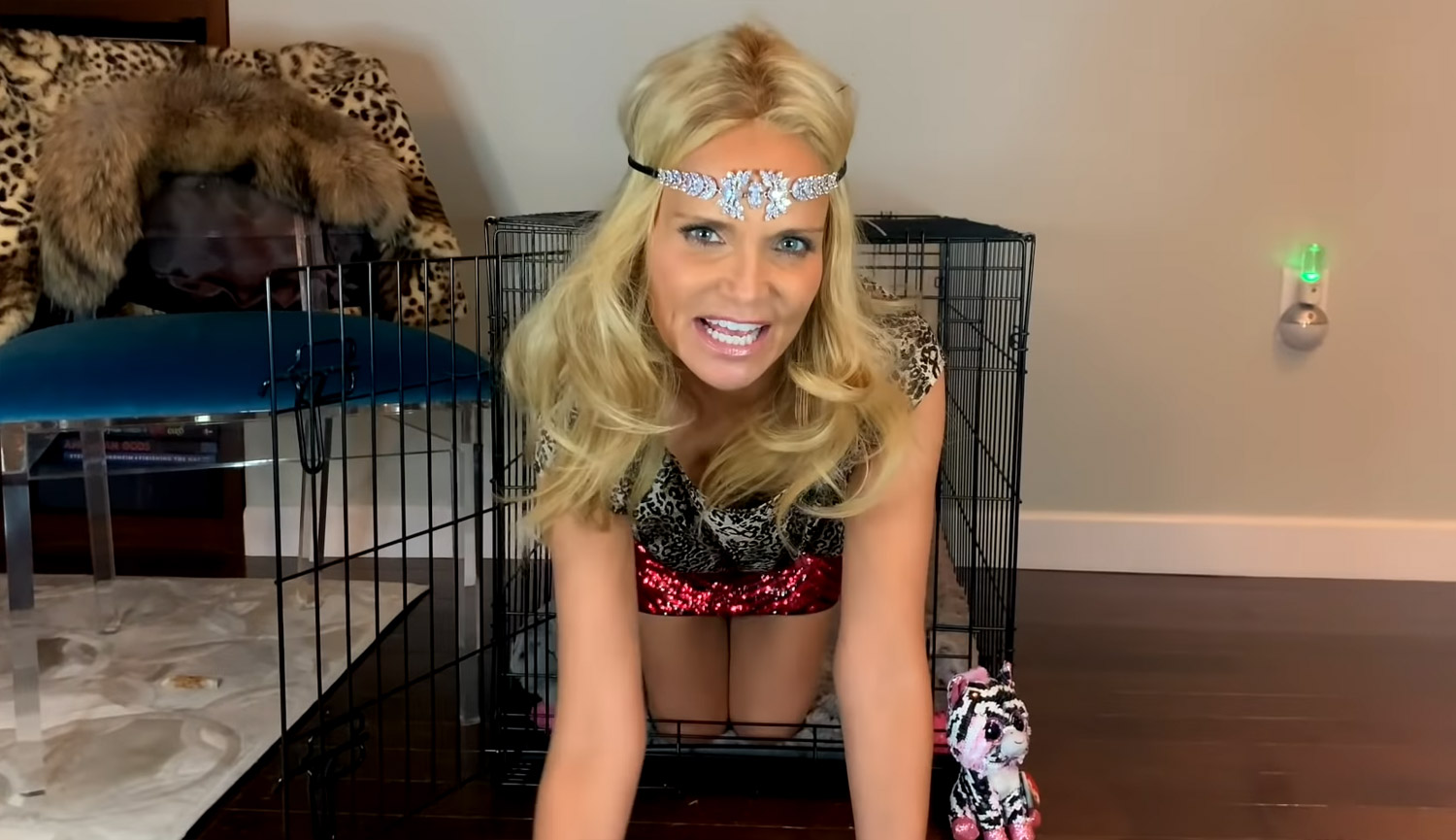
Kristin Chenoweth

Murder, mayhem, madness — and music? Composer Andrew Lippa is a self-confessed “Tiger Cub,” a die-hard fan of the Neflix documentary Tiger King, having spent hours binge-watching the show during quarantine. On March 28, he tweeted, “I’m making the musical of ‘Tiger King.’ Don’t try to stop me. Don’t tell me you have the rights. You don’t. I will crush it.” He was only half-joking.

After his post got over 2,000 likes, Lippa continued the thread for more than another 100 tweets. But he didn’t think much of the conversation, until Kurt Deutsch of Ghostlight Records asked him, “Are you serious? Do you really want to make a musical?” So, now he’s writing a score for Tiger King: The Musical (A Parody!) and will post the latest songs as he writes them over the next few weeks. He’s begun assembling an impressive group of artists to help.

First on board was Kristin Chenoweth, who premiered leading lady Carole Baskin’s first act finale, “Little Pieces.” The next song to drop was “Husband Number 2,” featuring Frankie Grande as Joe Exotic’s partner Travis Maldonado. This week Richard Kind was added to the roster as Baskin’s husband Howard, whose song is yet to be announced.

Posted in Online, Shows | Tagged , , , , , | Leave a comment

Essential Musicals: Cabaret

Joel Grey in "Cabaret" (1966)

In 1929, novelist Christopher Isherwood took a spring trip to Berlin and was so taken with the city that he moved there six months later. For the next four years, as Hitler rose to power, he kept a diary chronicling his life in the changing city. These entries provided the material for his 1939 short story collection, Goodbye to Berlin, which playwright John Van Druten adapted as I Am a Camera. In 1963, producer David Black commissioned composer Sandy Wilson to musicalize the play. Wilson had finished the book and most of the score when Black’s option on the material expired.

Producer Harold Prince picked up the option and hired Joe Masteroff to work on the book. He agreed to hear Wilson’s score but thought the music didn’t think suit what he had in mind, which was something more evocative of Kurt Weill, so he hired John Kander and Fred Ebb to create a new score.

As the team developed the show, Prince recalled his time in Germany after the war, particularly the Stuttgart nightclub Maxim’s, which employed “a dwarf MC, hair parted in the middle and lacquered down with brilliantine, his mouth made into a bright red cupid’s bow.” That figure became the show’s Master of Ceremonies, and Maxim’s became the show’s Kit Kat Club, where writer Cliff Bradshaw’s roommate Sally Bowles performs. The new focus led to a new title: Cabaret.

Just as the initial moments of Oklahoma! had defied audience expectations almost 25 years earlier, so did those of Cabaret when it opened on Broadway in 1966 with Bert Convy (Cliff), Jill Haworth (Sally), and Joel Grey (Master of Ceremonies). There was no curtain, just an empty stage with a large mirror hanging from above, reflecting the audience as they entered. There also was no overture, just a drumroll and cymbal crash leading into the opening number. Despite the initial shock, the musical won over its audiences. The production garnered 11 Tony Award nominations, winning eight (including best musical), and closed three years later, after 1,165 performances (the third longest-running musical at the time).

Director Harold Prince and choreographer Ron Field recreated their work for the show’s London debut in 1968 with Kevin Colson (Cliff), Judi Dench (Sally), and Barry Dennen (Master of Ceremonies), but the musical is best known through its 1972 film adaptation, written by Jay Allen and directed by Bob Fosse, starring Michael York, Liza Minnelli, and Joel Grey.

The film is quite different from the stage musical, not the least being the change in nationalities of Cliff and Sally (American and English, respectively, onstage) to Brian and Sally (English and American, respectively, onscreen). Most significant, though, was the elimination of all the “book songs.” (Before the stage show’s Boston tryout, Jerome Robbins has suggested the songs outside the cabaret be eliminated.) Kander and Ebb replaced several numbers and added others for the film. Replacements included “Mein Herr” (for “Don’t Tell Mama”) and “Money, Money” (for “The Money Song”). One addition was “Maybe This Time,” written in 1964 for Kaye Ballard. All three were incorporated into later stage productions.

Fosse also asked Hugh Wheeler, a friend of Isherwood’s, to revise Allen’s screenplay to ensure it was faithful to the original stories. Wheeler restored the subplot about the gigolo and Jewish heiress and made Brian bisexual instead of heterosexual (as Cliff is in the stage musical). The film was nominated for 10 Oscars, winning eight, and was inducted into the Library of Congress National Film Registry in 1995.

There was a short-lived Broadway revival in 1987, with Gregg Edelman, Alyson Reed, and Joel Grey, directed by Prince, but the most significant remounting was the 1993 London revival that Sam Mendes directed, starring Adam Godley, Jane Horrocks, and Alan Cumming. It differed substantially from the original stage production — a sparer, sexier, environmental production.  (The audience sat at cabaret tables and could order drinks.)

The 1998 Broadway revival based on this production starred John Benjamin Hickey, Natasha Richardson, and Cumming. It was nominated for 10 Tony Awards, winning best revival of a musical among its four trophies, and ran for 2,377 performances. In 2014, this version was brought back for a short-lived Broadway revival, again directed by Mendes, with Bill Heck, Michelle Williams, and Cumming.

The original 1966 cast album won the Grammy as Best Score from an Original Cast Show Album and spent 39 weeks on the Billboard charts, peaking at #37. The 1972 movie soundtrack spent 72 weeks on the Billboard charts, peaking at #25, and was inducted into the Grammy Hall of Fame in 2008.

Listen to the soundtrack and read The Making of Cabaret (1999) by Keith Garebian for more about the show’s creation.

NEXT, for another tale of struggling artists living in challenging times, listen to Rent, with book and score by Jonathan Larson.

THEN, explore Urinetown, by Greg Kotis (book and lyrics) and Mark Hollmann (lyrics and music), which Kotis had the idea for while on vacation in Europe — and encountering pay toilets for the first time.

Posted in History | Tagged , , , , , , , | Leave a comment

Essential Musicals: Fiddler on the Roof

Novelist Philip Roth called it “shtetl kitsch,” and writer Cynthia Ozick said it was an “emptied-out, prettified romantic vulgarization” of Sholem Aleichem’s work. Even if it wasn’t entirely true to its source material, Fiddler on the Roof did tackle the hard truths of a vanishing world: the universal (and eternal) generational battle between tradition and assimilation. And what some worried was “too Jewish” has become one of the most popular musicals in Japan and around the world.

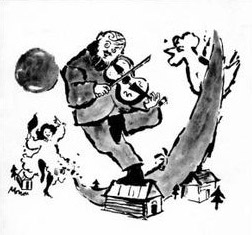
In 1961, lyricist Sheldon Harnick and composer Jerry Bock began meeting with librettist Joseph Stein to adapt Sholem Aleichem’s short stories. Their musical adaptation is an amalgam of the eight tales in Tevye the Dairyman, focusing on Tevye’s attempts to maintain his family’s religious and cultural traditions as outside influences encroach upon their lives in czarist Russia at the turn of the 20th century. The writers considered calling the show simply Tevye, before landing on a title suggested by Marc Chagall’s paintings, which also inspired Boris Aronson’s set design.

When original producer Fred Coe dropped out, Harold Prince stepped up and brought in director-choreographer Jerome Robbins. During rehearsals, lead actor Zero Mostel openly feuded with Robbins, whom he disliked because of his cooperation with the HUAC, while Robbins fought with Mostel over his improvisations of the dialogue and blocking. As the show progressed through tryouts in Detroit and Washington, Stein wrote five drafts of the book and Bock and Harnick wrote (and tossed most of) some 50 songs.

The show opened on Broadway on September 22, 1964, starring Mostel as Tevye, Maria Karnilova as his wife Golde, and Beatrice Arthur as Yente the matchmaker. It was nominated for ten Tonys, winning for best musical and eight other awards (including trophies for Prince, Mostel, Karnilova, Robbins, Stein, and Bock & Harnick). The production ran for a record-setting 3,242 performances, winning a special Tony in 1972 upon becoming the longest-running show in Broadway history, a record it held until 1979, when Grease surpassed it.

The original cast album spent 204 weeks on the Billboard charts, peaking at #7. It was nominated for a Grammy as best score from an original cast show album (losing to Funny Girl) and was inducted into the Grammy Hall of Fame in 1998. In 2020, the Library of Congress selected the album for preservation in its National Recording Registry.

The original London production opened in 1967 and played for 2,030 performances, starring Topol (Tevye) and Miriam Karlin (Golde). Topol also played Tevye in the 1971 film adaptation, directed by Norman Jewison, with Stein providing the screenplay. It became the highest-grossing film of 1971 and received eight Oscar nominations, including best picture.

After listening to the original cast album, learn more about the history of Fiddler by reading The Making of a Musical (1971) by Richard Altman or Barbara Isenberg’s Tradition! (2014) and watching Fiddler: A Miracle of Miracles, a 2019 documentary film by Max Lewkowic.

NEXT, for another masterful literary adaptation, listen to Man of La Mancha, with a book by Dale Wasserman (which he adapted from his 1959 teleplay I, Don Quixote, based on the mammoth 1615 novel Don Quixote by Cervantes) and a score by Mitch Leigh and Joe Darion. The original cast recording with Richard Kiley is definitive. The film and revival cast recordings are disappointing.

THEN, explore Les Misérables, an adaptation of Victor Hugo’s sprawling 1862 novel that began as a 1980 French concept album by Claude-Michel Schönberg, Alain Boublil, and Jean-Marc Natel, then was translated and adapted for the English stage by Herbert Kretzmer, Trevor Nunn, John Caird, and James Fenton. Among the unnecessary range of recordings, the choice is ultimately between Patti LuPone in the London cast or Randy Graff in the New York cast. Both women are effective as Fantine, but I favor the Broadway recording, since it includes Valjean’s “Bring Him Home.”

Posted in History | Tagged , , , , , , , , , , , | Leave a comment

Essential Musicals: The Fantasticks

As the size (and cost) of Broadway productions began to grow in the 1950s, several theater-makers left Times Square and settled in Greenwich Village, fashioning intimate playhouses out of bars, brownstones, and abandoned cinemas. By 1954, the Off-Broadway movement had its first musical success: a revival of The Threepenny Opera, which ran for six years. This encouraged more musicals. The 1959-60 season alone saw a dozen, including what was to become the most successful Off-Broadway musical: The Fantasticks, which ran for a record-setting 42 years.

Based on Edmond Rostand’s Les Romanesques, the show centers around two neighboring fathers who trick their children into falling in love, by pretending to feud. In the adaptation’s first incarnation, called Joy Comes to Deadhorse, Tom Jones and composer John Donald Robb set the story on adjoining Southwestern ranches, where an Anglo boy and an Hispanic girl fall in love. Jones was not happy with this version and, with Robb’s assent, teamed with composer Harvey Schmidt to try again. The new piece, retitled The Fantasticks (the name of George Fleming’s 1900 translation of Rostand’s play), premiered on a bill of one-acts at Barnard College in summer 1959.

Producer Lore Noto saw that production and commissioned Jones and Schmidt to expand the musical into a full-length. The two-act version of The Fantasticks premiered a few months later, opening at the Sullivan Street Playhouse on May 3, 1960, with Kenneth Nelson and Rita Gardner as the children Matt and Luisa and Jerry Orbach as the narrator El Gallo.

Though expanded to two acts, the show remained trim. The cast comprised eight actors, the orchestra two musicians (piano and harp). The set was a small wooden platform with a bench, trunk, and cardboard moon hung on a pole. Word Baker’s stylized direction combined vaudeville showmanship with commedia dell’arte, reflected in Ed Wittstein’s set design that resembled a traveling pageant wagon, its raised platform anchored by six poles. Wittstein also designed the costumes, props, and lights! At a time when Broadway musicals cost cost $250,000, Noto spent $900 on the set and $541 on costumes.

Village Voice critic Michael Smith wrote, “I did something for the first time last week. Having seen the show free on Tuesday, its opening night, I bought tick­ets and went back on Thurs­day.” It took some nine weeks, but word of mouth spread, and as Smith had, audience members returned again and again to see the show, filling its 150-seat theater for the next four decades. Smith noted part of the reason: “The play’s thesis is that ‘without a hurt the heart is hol­low,’ a dangerously romantic no­tion these days, and the most elaborate and sophisticated art is employed to catch the au­dience in its simplicity. What are usually limi­tations off Broadway become advantages.”

A film adaptation was made in 1995, directed by Michael Ritchie, with Joey McIntyre (Matt), Jean Louisa Kelly (Luisa), and Jonathon Morris (El Gallo), but it wasn’t released until 2000 and spent only a few days in theaters. An abbreviated version of the show appeared on TV in 1964, with John Davidson (Matt), Susan Watson (Luisa), and Ricardo Montalban (El Gallo).

When the show ended its run on Sullivan St. in 2002, it had seen 17,162 performances, making it the world’s longest-running musical. Just four year later, the show was revived, closing in 2017 after another decade onstage and an additional run of 4,390 performances. That production starred Santino Fontana (Matt), Sara Jean Ford (Luisa), and Burke Moses (El Gallo), directed by Jones.

Highlights of the 1960 original cast album include “Try to Remember” and “Soon It’s Gonna Rain.” For more about the show’s creation, read Donald Farber’s The Amazing Story of The Fantasticks (2005).

NEXT, explore another Off-Broadway hit: Little Shop of Horrors (1982), with book and lyrics by Howard Ashman and music by Alan Menken. The original production ran for five years and 2,209 performances, making it the third-longest running Off-Broadway musical.

THEN, listen to the 1954 show that put Off-Broadway on the map: The Threepenny Opera, with book and lyrics by Bertolt Brecht (adapted and translated by Marc Blitzstein) and music by Kurt Weill, starring the incomparable Lotte Lenya, Weill’s wife.

Posted in History | Tagged , , , , , , | Leave a comment

Essential Musicals: Gypsy

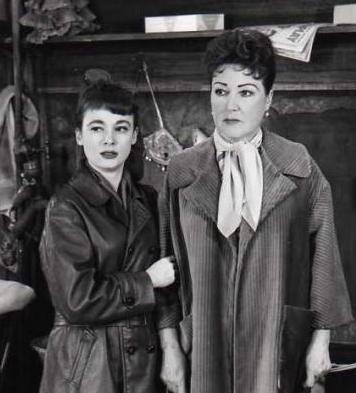
Church and Merman in "Gypsy" (1959)

New York Times critic Ben Brantley believes Gypsy “may be the greatest of all American musicals.” He is not alone. Previous Times critic Frank Rich considers the show to be “Broadway’s own brassy, unlikely answer to King Lear.” The Lear of the musical is not Gypsy, though, but her mother, Rose, whom fellow Times critic Clive Barnes has described as “one of the few truly complex characters in the American musical.” Lyricist Stephen Sondheim has described Rose as “a very American character, a gallant figure and a life force.”

When producer David Merrick read a chapter of Gypy Rose Lee’s 1957 memoir in Harper’s Magazine, he immediately sought the musical rights. Ethel Merman and Jerome Robbins were soon onboard, and Merrick then approached Arthur Laurents to write the book. Laurents found his way into the story by focusing on how Rose, the ultimate show-business mother, lived her life through her children.

Irving Berlin and Cole Porter were both asked but declined to write the score, so Robbins asked Stephen Sondheim (whom he and Laurents had just worked with on West Side Story). Sondheim agreed, but Merman didn’t want an unknown composer, so Jule Styne was enlisted to write the music to Sondheim’s lyrics.

After tryouts in Philadelphia and New Haven, the show opened May 21, 1959, on Broadway, directed and choreographed by Jerome Robbins and starring Merman as Rose, Sandra Church as Gypsy, and Jack Klugman as Herbie. The production received eight Tony nominations, including Best Musical, but failed to win a single trophy. After two years and 702 performances, Merman took the show on the road across America in 1961. The following year, the film adaptation premiered, with Rosalind Russell as Rose, Natalie Wood as Gypsy, and Karl Malden as Herbie.

There have been numerous productions since then. Gypsy made its West End debut in 1973, with Angela Lansbury as Rose, directed by Arthur Laurents. Lansbury took that production on a 24-week tour of North America, ending with a run on Broadway in 1974. The second Broadway revival opened in 1989, starring Tyne Daly as Rose, again with Laurents as director. The next major production was the 1993 TV adaptation with Bette Midler. The show then saw two more Broadway revivals: one in 2003 with Bernadette Peters and one in 2015 with Patti LuPone. An acclaimed West End revival opened in 2015, with Imelda Staunton. That production was filmed for TV and released on DVD in 2016.

There are recordings of each of the above productions, but the 1959 original cast remains definitive. That album stayed 116 weeks on the Billboard charts, peaking at #13, and was inducted into the Grammy Hall of Fame in 1998. It also won a Grammy, as did the 2003 revival album with Peters, whom Laurents described as “brilliant, original.”

For more about the show’s creation, read Keith Garebian’s The Making of Gypsy (1994).

NEXT, for a quieter backstage tale, listen to the inventive 1961 musical Carnival (book by Michael Stewart, score by Bob Merrill), based on the 1953 film Lili, about a French waif’s relationship with a carnival puppeteer.

THEN, explore the backlot world in the 1982 musical Nine (book by Arthur Kopit, score by Maury Yeston), an equally inventive show based on Federico Fellini’s semi-autobiographical film 8½, about a film director facing a midlife crisis.

Posted in History | Tagged , , , , , , , , , , , , , | Leave a comment

2020 Outer Critics Circle Honorees

Yesterday by video feed, Kristin Chenoweth, Bryan Cranston, Patti LuPone, Lin-Manuel Miranda, and Patrick Stewart announced the 70th annual Outer Critics Circle Award honorees for the 2019-20 Broadway and Off-Broadway season. In lieu of selecting traditional nominees and one winner in each category, this year’s awards named up to five honorees in each of 26 categories, plus four honorees of the John Gassner Award for a new American play. Leading the pack with the most honors are two Broadway musicals: Moulin Rouge! (11) and Jagged Little Pill (8).

The shows named Outstanding New Broadway Musical were Jagged Little Pill (also named for its book by Diablo Cody), Moulin Rouge!, and Tina.

The shows named Outstanding New Off-Broadway Musical were Darling Grenadine, Octet (also named for its score by Dave Malloy), The Secret Life of Bees (also named for its book by Lynn Nottage and its score by Susan Birkenhead and Duncan Sheik), Soft Power (also named for its book by David Henry Hwang and its score by Jeanine Tesori and David Henry Hwang), and A Strange Loop (also named for its book and its score by Michael R. Jackson).

The shows named Outstanding Revival of a Musical were the Off-Broadway productions of Little Shop of Horrors and The Unsinkable Molly Brown and the Broadway production of West Side Story.

Other musical writers named were Mark Saltzman (for his book to Romeo and Bernadette) and Ross Golan (for his score to The Wrong Man).

Posted in Awards, Stage | Tagged , , , , , , , , , , , , | Leave a comment

Essential Musicals: West Side Story

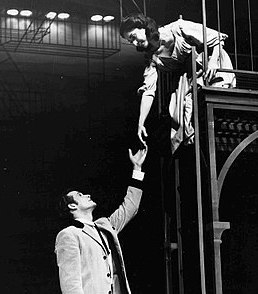
Kert and Lawrence in "West Side Story" (1957)

When West Side Story premiered in 1957, it marked a turning point in American musical theater — “a provocative and artful blend of music, dance, and plot,” as one critic noted — but getting the work to Broadway had not been easy. “Everyone told us that it was an impossible project,” composer Leonard Bernstein told Rolling Stone, “Besides, who wanted to see a show in which the first-act curtain comes down on two dead bodies lying on the stage?” It was a decade-long series of disappointments and setbacks, but the creative team persevered.

It began in 1947, when director-choreographer Jerome Robbins approached Bernstein and writer Arthur Laurents with an idea for a musical adaptation of Romeo and Juliet set in the Lower East Side of Manhattan, focusing on Catholic Jets and Jewish Emeralds. Laurents wrote a draft of East Side Story, but the team didn’t think it worked, so they dropped the idea.

Years later, Laurents and Bernstein met for drinks in Hollywood, and their conversation turned to Chicano turf wars making headlines. Bernstein suggested they rework East Side Story on that idea, but being more familiar with New York, Laurents suggested Puerto Ricans in Harlem. Robbins was enthusiastic, and Laurents quickly wrote the first draft of West Side Story with Polish-American Jets and Puerto Rican Sharks.

At an opening night party, Laurents met Stephen Sondheim. Bernstein had decided to concentrate on the music, so the team was shopping for a lyricist. With that, the team was set: book by Arthur Laurents, music by Leonard Bernstein, and lyrics by Stephen Sondheim. The show went through numerous changes over the next few years. Characters came and went. Songs were put it and taken out.

Through it all, Laurents explained their guiding principle: “Just as Tony and Maria, our Romeo and Juliet, set themselves apart from the other kids by their love, so we have tried to set them even further apart by their language, their songs, their movement. Wherever possible in the show, we have tried to heighten emotion or to articulate inarticulate adolescence through music, song or dance.”

Then two months before the show was to begin rehearsals, the lead producer dropped out. Luckily, Sondheim was able to get his friend Harold Prince to step in, and the show moved forward. Another setback came when Columbia Records became reluctant to record such a “depressing and difficult score.” In the end, though, they did record the original cast album, which spent 191 weeks on the Billboard charts (peaking at #5) and was inducted into the Grammy Hall of Fame in 1991.

Luckily, the tryout runs in Washington, D.C., and Philadelphia were well received, and the show opened in New York on September 26, 1957, starring Larry Kert (Tony), Carol Lawrence (Maria), and Chita Rivera (Anita). “The American theater took a venturesome forward step,” New York Daily News critic John Chapman wrote. “This is a bold new kind of musical theater.”

The production was nominated for six Tonys (with Robbins winning for choreography) and ran for 732 performances before beginning a national tour in 1959, which returned to Broadway for another 249 performances. The 1961 film adaptation, written by Ernest Lehman and directed by Robert Wise and Robbins, starred Richard Beymer as Tony (dubbed by Jimmy Bryant), Natalie Wood as Maria (dubbed by Marni Nixon), and Rita Moreno as Anita. It was nominated for 11 Oscars and won 10, including Best Picture.

Either the 1957 Broadway cast or 1961 film cast are worth a listen. To learn more about the show’s creation, read Keith Garebian’s The Making of West Side Story (1995). You can also compare the libretto to William Shakespeare’s tragedy in the 1965 Dell edition.

NEXT, listen to the show that was chosen over West Side Story for Best Musical at the Tonys: The Music Man, with book, music, and lyrics by Meredith Willson.

THEN, explore another musical about teenage life in the 1950s — a world away from the Upper West Side of Manhattan: Bye Bye Birdie, with book by Michael Stewart, music by Charles Strouse, and lyrics by Lee Adams.

Posted in History | Tagged , , , , , , , , , | Leave a comment