Essential Musicals: My Fair Lady

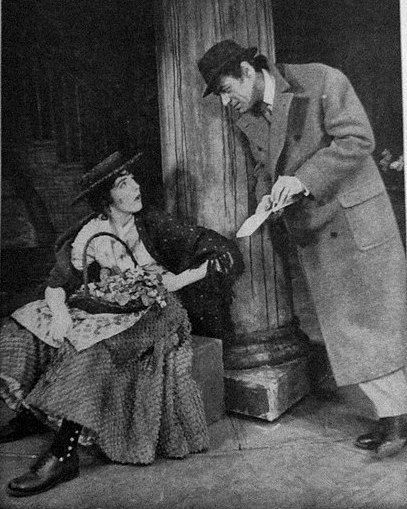
Andrews and Harrison in "My Fair Lady" (1956)

My Fair Lady has been called “the perfect musical,” but it took several decades and several attempts before George Bernard Shaw’s 1913 play Pygmalion eventually found its singing voice. The journey began in the 1930s with a chance encounter between Nobel laureate Shaw and struggling film-maker Gabriel Pascal on a Mediterranean beach. Shaw enjoyed Pascal’s enthusiasm and bravado, the story goes, so he told the young man to call him if he was ever in need. A few years later, Pascal did — and managed to leave the meeting with the rights to Shaw’s plays.

Pascal’s first move was to film Pygmalion, which became an international hit. He then tried to convince Shaw to turn it into a musical, but Shaw had a bad experience with the adaptation of Arms and the Man and refused. After Shaw died in 1950, Pascal turned his thoughts again to the musical. Richard Rodgers and Oscar Hammerstein were interested, but they abandoned the idea as unworkable.

Eventually, Pascal asked Alan Jay Lerner, but as other writers had, he and partner Frederick Loewe gave up. Two years later, though, Lerner began thinking about the musical again and realized that he didn’t need to follow the “rules” for adaptations, which had begun to fossilize in the years since since Oklahoma! He saw that Shaw’s play needed few changes apart from “adding the action that took place between the acts of the play.”

Indeed, Lerner (book and lyrics) and Loewe (music) changed little in the story of Cockney flower girl Eliza Doolittle and elocution professor Henry Higgins other than adding several scenes that Shaw had subsequently written for Pascal’s 1938 film, including the Embassy Ball sequence and the ending.

After tryouts in New Haven, Conn., and Philadelphia, the show opened March 15, 1956, at Broadway’s Mark Hellinger Theatre and ran a record-breaking 2,717 performances, surpassing Oklahoma! as the longest-running musical. The original cast included Julie Andrews (Eliza) and Rex Harrison (Henry) as well as Robert Coote (Pickering) and Stanley Holloway (Doolittle), with direction by Moss Hart and choreography by Hanya Holm. New York Herald Tribune critic Walter Kerr called it “a miraculous musical,” and New York Times critic Brooks Atkinson declared it “one of the best musicals of the century.”

The production won six Tony Awards, including best musical, leading actor (Harrison), and director (Hart). The original cast recording became the best-selling album of 1956, topping the charts for 15 weeks and remaining on Billboard’s album chart for 480 weeks, one of the longest runs of any recording. In 1977, the album was inducted into the Grammy Hall of Fame.

The Oscar-winning film adaptation premiered in 1964. Harrison (Henry) and Holloway (Doolittle) reprised their roles, with Audrey Hepburn as the new Eliza (her singing dubbed by Marni Nixon) and Wilfrid Hyde-White as Pickering. Lerner contributed the screenplay, directed by George Cukor.

Listen to the 1956 original cast recording, still the best version of the show. To learn about the musical’s creation, read Keith Garebian’s The Making of My Fair Lady (1993). To compare the original play script and the musical libretto, read the Signet Classic edition (1980), which includes both.

NEXT, for another faithful play adaptation, listen to Hello, Dolly! (1964), written by Michael Stewart (book) and Jerry Herman (music and lyrics), based on Thornton Wilder’s The Matchmaker (1954).

THEN, for another adaptation of British literature, listen to Oliver! (1962), written by Lionel Bart (book, music, and lyrics), based on the Charles Dickens novel Oliver Twist (1839).
Posted in History | Tagged , , , , , , | Leave a comment

Essential Musicals: Guys and Dolls

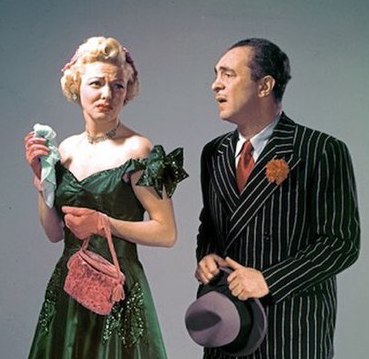
Blaine and Levene in "Guys and Dolls" (1950)

From the Mississippi River banks to the Oklahoma plains, and beyond, the best musicals effectively evoke their settings. Guys and Dolls was the first (and so far best) Broadway musical to bring Broadway to life — not the Broadway of bright lights and theater marquees but the Broadway of streetlights and after-hours clubs — and with infectious affection. As director Jerry Zaks told NPR, “I use the word ‘joy’ a lot, but that’s what I think the show is all about: a kind of infectious joy that makes you just want to join them up there on stage.”

The idea began with producers Cy Feuer and Ernest Martin, who wanted to bring the world created by Damon Runyon to the stage. They hired Frank Loesser to write the score and Jo Swerling to write the book. The producers found the first version of Swerling’s book unusable, so they asked Abe Burrows to step in. The challenge was, though, that Loesser had already written much of the score by then. Burrows later wrote, “Loesser’s fourteen songs were all great, and the [new book] had to be written so that the story would lead into each of them.”

During its tryout in Philadelphia, every performance saw new changes. “About 1:00 in the morning, Frank called me,” actor Isabel Bigley recalled, “and we worked on [a new song] till about 5:00 in the morning. … We put it in the matinee.” Actor Robert Alda said, “Forty of the 41 shows were completely different. In other words, we continuously were making changes.”

The main story line is from “The Idyll of Miss Sarah Brown,” in which a gambler Sky Masterson takes a bet that he can make any woman fall in love with him. The woman of his current conquest is missionary Sarah Brown. (You can listen to a 1949 radio episode of the story here.) The subplot involves gambler Nathan Detroit and his longtime fiancée Adelaide.

The role of Adelaide was created specifically to fit Vivian Blaine’s talents, as was the role of Nathan to suit Sam Levene, who was a great actor but a bad singer. Loesser adjusted the score to accommodate Levene’s limitations, which is why Nathan has only one song: the duet “Sue Me.” Loesser also structured the song so that Levene and Blaine never sang at the same time during the duet.

The show premiered in New York on November 24, 1950, starring Robert Alda (Sky), Sam Levene (Nathan), Isabel Bigley (Sarah), and Vivian Blaine (Adelaide), with direction by George S. Kaufman and choreography by Michael Kidd. It ran for 1,200 performances and won five Tonys: best musical, leading actor (Alda), featured actress (Bigley), choreography, and direction. New York Journal American critic John McClain wrote, “It is the best and most exciting thing of its kind since Pal Joey.” New York Times critic Brooks Atkinson simply said, “It is a work of art.”

Guys and Dolls was chosen as the winner of the 1950 Pulitzer Prize for Drama. However, because Burrows was on the Red Channelsblack list,” the trustees of Columbia University vetoed the drama committee’s selection, and no prize was awarded that year.

The musical received a 1955 film adaptation starring Marlon Brando (Sky), Jean Simmons (Sarah), Frank Sinatra (Nathan), and Vivian Blaine (reprising the role of Adelaide). Another original cast member reprising their role was Stubby Kaye as Nicely-Nicely Johnson, who sings the show-stopping production number “Sit Down, You’re Rockin’ the Boat.” The film was directed by Joseph L. Mankiewicz, who co-wrote the screenplay with Ben Hecht.

The 1992 revival was the most successful Broadway return, running for 1,143 performances. Directed by Jerry Zaks, it starred Nathan Lane (Nathan), Peter Gallagher (Sky), Faith Prince (Adelaide) and Josie de Guzman (Sarah).

The original cast recording was inducted into the Grammy Hall of Fame in 1998. In addition to that version, the 1992 revival cast is worth a listen. To learn about the creation of the show, read Keith Garebian’s The Making of Guys and Dolls (2010). For more, try producer Cy Feuer’s 2003 autobiography I Got the Show Right Here.

NEXT, for a backstage look at the Broadway theater world, listen to Kiss Me, Kate (1948), written by Bella and Samuel Spewack (book) and Cole Porter (music and lyrics), about the professional (and personal) complications of a Broadway-bound musical adaptation of The Taming of the Shrew.

THEN, for another story about unlikely love in which opposites attract (this time a union rep and factory superintendent), listen to The Pajama Game (1954), written by Richard Bissell and George Abbott (book) and Richard Adler and Jerry Ross (music and lyrics).

Posted in History | Tagged , , , , , , , , , , , | Leave a comment

Essential Musicals: Oklahoma!

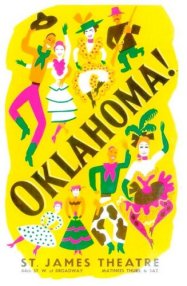
I called Show Boat the most influential American musical, but historian Thomas Hischak argues, “Not only is Oklahoma! the most important of the Rodgers and Hammerstein musicals, it is also the single most influential work in the American musical theater.” The fully integrated show made great strides in 1927 with Show Boat, but it firmly took root in 1943 with Oklahoma! — and began a Golden Age of American musical theater.

Building on the innovations he employed in Show Boat, Hammerstein went further in challenging the conventions about what a musical “should” look like, giving Oklahoma! a quiet opening (not a big production number) and a 15-minute “dream ballet” as its first act finale. Producer Mike Todd famously walked out during the show’s Boston tryout, saying, “No legs, no jokes, no chance.”

For their first collaboration, composer Richard Rodgers and librettist Oscar Hammerstein II adapted the 1931 Lynn Riggs play Green Grow the Lilacs, set in 1906 around Claremore, Indian Territory (later the state of Oklahoma). The musical tells the story of farm girl Laurey Williams and her two rival suitors, cowboy Curly McLain and farmhand Jud Fry. A subplot involves Laurey’s friend Ado Annie and cowboy Will Parker.

The Theatre Guild had produced the Riggs play. It wasn’t successful in 1931, but Guild producer Theresa Helburn saw a summer-stock version in 1941 that added folk songs and square dances, leading her to think the play could make a successful musical. She contacted Rodgers and his partner at the time, Lorenz Hart, whom the Guild had previously produced. Given Hart’s increasingly erratic nature, Rodgers asked Hammerstein to collaborate with them. Hart soon lost interest in the show and told Rodgers to continue on with Hammerstein.

The original Broadway production opened on March 31, 1943, directed by Rouben Mamoulian and choreographed by Agnes de Mille, starring Joan Roberts (Laurey), Alfred Drake (Curly), Howard Da Silva (Jud Fry), Celeste Holm (Ado Annie), and Lee Dixon (Will Parker). It ran for an unprecedented 2,212 performances (a record it held for a decade, until bested by My Fair Lady) and won a special Pulitzer Prize in 1944. New York Daily News critic Burns Mantle noted, “Oklahoma! really is different — beautifully different. … Oklahoma! seems to me to be the most thoroughly and attractively American musical comedy since Edna Ferber’s Show Boat.”

The 1955 film adaptation starred Shirley Jones (in her screen debut as Laurey), Gordon MacRae (Curly), Rod Steiger (Jud), Gloria Grahame (Annie), and Gene Nelson (Will), with direction by Fred Zinnemann (his only film musical) and a screenplay by Sonya Levien and William Ludwig. Rodgers and Hammerstein oversaw the film to prevent changes typically made in musical adaptations, such as interpolating outside songs.

Decca recorded most of the songs from the original stage production in 1943, creating the first Broadway cast album. It sold more than a million copies, so the label called the cast back into the studio to record three selections not originally included. In 2000, Decca released the full recording on CD.

For more about the making of Oklahoma!, read Max Wilk’s OK! The Story of Oklahoma!: A Celebration of America’s Most Beloved Musical (2002).

NEXT, listen to Annie Get Your Gun (1946) by Irving Berlin (music and lyrics) with Dorothy and Herbert Fields (book). After the success of Oklahoma!, Rodgers and Hammerstein began producing their shows and others. Dorothy Fields brought them the idea for this show, and they asked Jerome Kern to work with her on lyrics and her brother Herbert on book. A week after Kern began writing, he died, and R&H asked Irving Berlin to step in. It became the most successful of Berlin’s half dozen book shows. Perhaps a bit better than the original Broadway recording, Ethel Merman shines in the 1966 Lincoln Center production.

THEN, to get a taste of the work of that other R&H (Rodgers and Hart), listen to the 1950 studio cast recording of Pal Joey, the team’s best show. The original 1940 cast wasn’t preserved, so we don’t have Gene Kelly’s interpretation of the seminal musical antihero, but leading actress Vivienne Segal did return to recreate her performance.

Tomorrow, the PBS series Poetry in America will spotlight the work of Hammerstein protégé Stephen Sondheim with a discussion of the song “Finishing the Hat,” from his 1984 Pulitzer-winning Sunday in the Park with George. Taking part in the discussion are Sondheim veteran actors Raúl Esparza and Melissa Errico, who were Georges and Dot in the Kennedy Center production. Click here to watch a preview.

Posted in History | Tagged , , , , , , , , , , , , | Leave a comment

2020 Pulitzer Prize for Drama

A Strange Loop

This afternoon, award administrator Dana Canedy announced the 104th class of Pulitzer Prize winners. The prize for drama, given “for a distinguished play by an American author, preferably original in its source and dealing with American life,” also includes a $15,000 cash award.

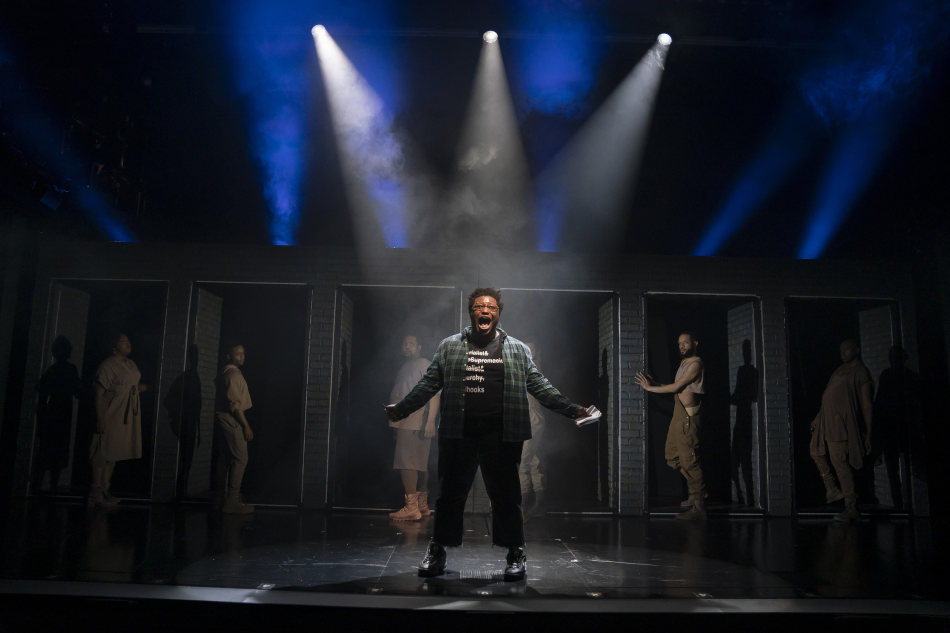
This year’s winner is Michael R. Jackson’s A Strange Loop, which the award committee described as “a metafictional musical that tracks the creative process of an artist transforming issues of identity, race, and sexuality that once pushed him to the margins of the cultural mainstream into a meditation on universal human fears and insecurities.” It is the tenth musical to win the prize since 1917.

Two finalists were also named. One is Will Arbery’s Heroes of the Fourth Turning, described as “a scrupulously hewn drama centering on four alumni of a conservative Catholic college who confront themselves and each other, clashing over theology, politics and personal responsibility.”

The other finalist is David Henry Hwang and Jeanine Tesori’s Soft Power, described as “a multi-layered and mischievous musical that deconstructs a beloved, original American art form to examine the promise and the limits of representation in both the theatrical and political senses of the word.”

All three shows premiered Off-Broadway: A Strange Loop and Heroes of the Fourth Turning at Playwrights Horizons, Soft Power at the Public Theater.

This year’s jury included artistic director Wendy Goldberg (National Playwrights Conference), writer-editor Naveen Kumar, critic Dominic Papatola (Pioneer Press), director Janice Simpson (CUNY School of Journalism), and professor Alisa Solomon (Columbia University).

Posted in Awards, Stage | Tagged , , , | Leave a comment

Essential Musicals: Show Boat

To learn the functional basics about any subject and to accumulate a working vocabulary of that field, you should know something about its history. Even artistic revolutionaries like Picasso studied the Old Masters. You wouldn’t drive forward into moving traffic without first taking at least a glance backward, would you? Over the next few weeks, I’ll offer a dozen original stage musicals and a dozen original film musicals (with some optional detours) that any student of musical theater should be familiar with.

Let’s begin with perhaps the most influential American musical: Show Boat, written by Oscar Hammerstein II (book and lyrics) and Jerome Kern (music), based on Edna Ferber’s best-selling 1926 novel. Hammerstein and Kern had become tired of the fluffy entertainment around them: the cotton-candy operettas and high-kicking revues that filled most American stages. Each man had a substantial history in those forms, but they sought something new.

When Kern read Ferber’s novel, he saw its potential as a powerful — and musical — stage piece. Luckily Ferber agreed, and Kern brought the idea to the most successful producer of that time: Florenz Ziegfeld, best known for his fluffy Follies revues. For some reason, Ziegfeld took a chance on the show, later writing, “This is the best musical comedy I have ever been fortunate to get a hold of. I am thrilled to produce it. This show is the opportunity of my life.” He wasn’t wrong to support such an incongruous idea.

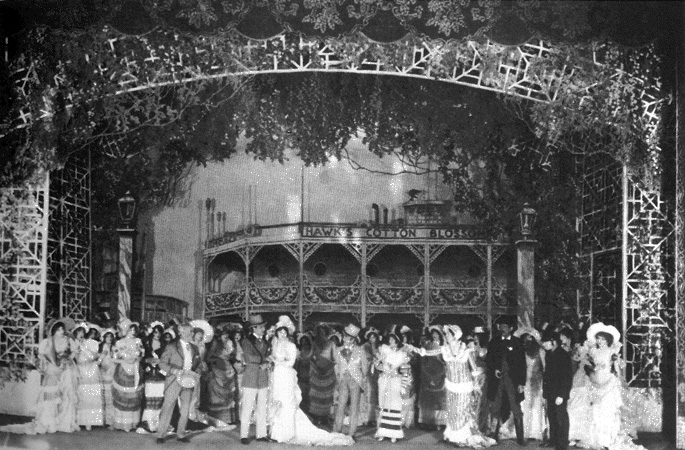
The story centers on life aboard the Cotton Blossom, a Mississippi River show boat, particularly the romance of Magnolia Hawks and Gaylord Ravenal from 1887 to 1927. The subplot involves Magnolia’s friend Julie La Verne. In addition to creating a new form of musical entertainment, the show put racial issues centerstage. In fact, it was the first racially integrated musical on Broadway — black and white performers sang alongside each other. As Ferber’s novel did, the musical also prominently featured an interracial marriage and a character of mixed race passing for white.

The show opened at the Ziegfeld Theatre on Dec. 27, 1927, with Norma Terris (Magnolia), Howard Marsh (Gaylord), Helen Morgan (Julie), and Jules Beldsoe (Joe). It was staged by Hammerstein and ran for 572 performances. After closing in May 1929, the production toured extensively, featuring Irene Dunne as Magnolia. She appeared in the 1936 film adaptation with Allan Jones (Ravenal), Helen Morgan (Julie), and Paul Robeson (Joe). Directed by James Whale, it’s a faithful screen adaptation, in part because it featured four members of the original Broadway cast and a screenplay by Hammerstein.  A more popular (but slightly altered) 1951 version featured Kathryn Grayson and Howard Keel in the lead roles, with Ava Gardner and William Warfield in the supporting roles.

The musical’s notable songs include “Ol’ Man River,” “Make Believe,” and “Can’t Help Lovin’ Dat Man.” There isn’t a recording of the full 1927 original cast, but a 1932 studio recording did include Helen Morgan (Julie) and Paul Robeson (Joe) — issued in conjunction with the 1932 stage revival  featuring those two actors, directed by Hammerstein. Among the numerous other recordings available, the best is the 1988 studio cast, which was the first to record the entire score, original orchestrations, and uncensored lyrics. It features Frederica von Stade (Magnolia), Jerry Hadley (Gaylord), Teresa Stratas (Juilie), and Bruce Hubbard (Joe).

Among the many stage versions, the most successful has been the 1994 Broadway revival, directed by Harold Prince. That production ran for 947 performances, before touring around the world. Prince’s production trimmed the book, reworked the score, and highlighted its racial elements.

For more about the making of the show, read Show Boat: The Story of a Classic American Musical (1977) by Miles Kreuger.

NEXT, take a detour to study another show of that era that tackled racism: Porgy and Bess, by DuBose Heyward (book and lyrics) and George Gershwin (music), which opened in 1935 on Broadway (yes — a Broadway theater, not an opera house). The best recording is from the 1976 Houston Grand Opera production.

THEN, explore the popular musical entertainment that preceded Show Boat by listening to the 1992 Welsh National Opera recording of the operetta The Mikado, the masterpiece of W.S. Gilbert (book and lyrics) and Arthur Sullivan (music) that premiered on Broadway in 1885.

Posted in History | Tagged , , , , | Leave a comment

2020 Lucille Lortel Awards

Octet

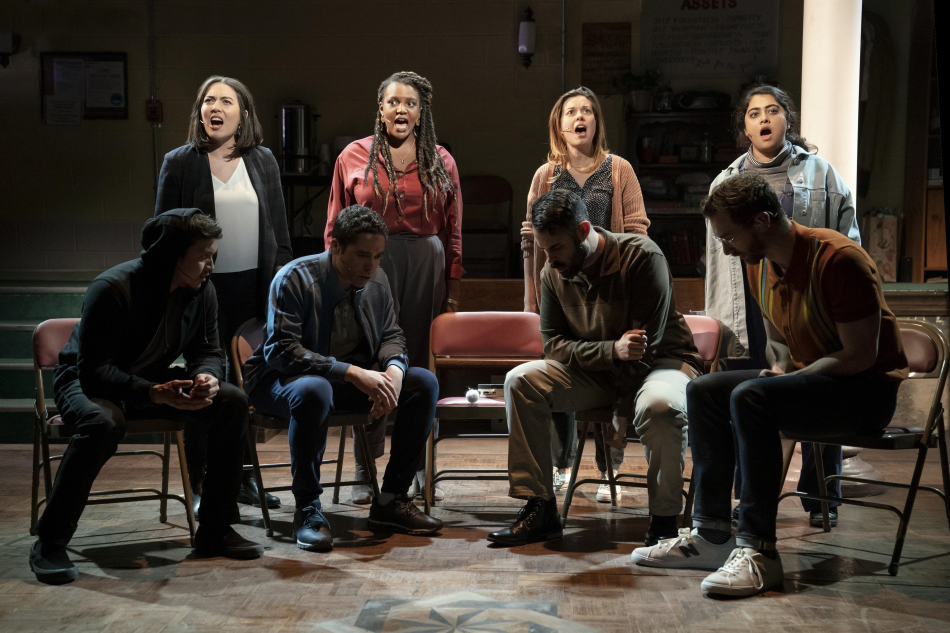
Last night, Mario Cantone hosted the Lucille Lortel Award ceremony online. The big musical winner of the night was Octet, which was named Outstanding Musical of the 2019-20 Off-Broadway season. The production also picked up honors for Annie Tippe as Outstanding Director and Kuhoo Verma as Outstanding Featured Actress in a Musical.

A Strange Loop picked up two honors: one for Larry Owens as Outstanding Lead Actor in a Musical and another for John-Andrew Morrison as Outstanding Featured Actor in a Musical, in a tie with Christian Borle of Little Shop of Horrors.

Among the other musical winners, the play with music for colored girls who have considered suicide / when the rainbow is enuf was named Outstanding Revival, Travis Wall of The Wrong Man was named Outstanding Choreographer, and Grace McLean of In the Green was named Outstanding Lead Actress in a Musical.

Posted in Awards, Stage | Tagged , , , , , , , , , , | Leave a comment

Making Musicals: Finding Your Next Idea

As soon as you’ve completed one musical, start the next. Don’t wait for a reading or a production — or anything. Of course, continue to pursue those avenues, but particularly if you’re a new writer, you need to keep your muscles primed by creating one short original musical after another. Short because you’re learning how musicals work (and how you work), and original because you don’t yet have the reputation to convince copyright holders to let you adapt their works, nor likely the money to afford a sufficient “option” time to complete the project.

So, when you’re stuck without an idea for your next project, where do you turn? There are two basic choices to help guide you. One choice is whether to write an original or an adaptation. As noted, new writers would be best served by developing an original idea. (When you’re ready to write a full-length, you might then consider adapting a work in the public domain, which we’ll talk about in a bit.) The other choice is whether to base your story on fact or on fiction.

First, let’s consider an original musical based on fact. These are usually stories rooted in some personal memory. Examples of shows with autobiographical roots include Avenue Q (Jeff Marx’s work experience with Sesame Street), The Last Five Years (Jason Robert Brown’s romantic experience), Tick, Tick … Boom! (Jonathan Larson’s experience as a writer), and [title of show] (Hunter Bell’s writing experience). Notice that these examples are all early works by new writers.

You might also consider an historic event (as did Come from Away, The Scottsboro Boys, 1776, and Titanic) or public figure (as did Assassins, Six, Bloody Bloody Andrew Jackson, and Evita). Whether personal or public, history has already provided you with an ending and a series of domino events leading to that ending.

Next, let’s look at an original musical based on fiction. These are stories of your own imagination, your own “what if.” What if an average American family adopted an alien? That’s Bat Boy. What if my grandmother won the lottery? That’s In the Heights. This option may be harder than the first, because you have to invent all the domino events in your plot, but you also don’t need to feel obligated to the historical record. As with an original musical based on fact, a news story may provide the spark, but the imaginative what ifs are all yours.

Before we talk about adaptation, let’s talk about copyright. As of 1998, U.S. copyrights are good for the life of the author plus 70 years or, for a corporation, 120 years after creation or 95 years after publication. Anything beyond those parameters becomes part of the public domain, and you don’t need to ask permission to adapt the work. In practical terms, this means that new (and/or poor) writers who can’t come up with an original idea should look for a public domain work to adapt. Project Gutenberg is a good site to begin your search.

Now, let’s look at a musical adaptation based on fact. These are usually from a published biography. Other suitable nonfiction works in the public domain are rare. One spark for Urinetown was the economic tract An Essay on the Principle of Population by Thomas Malthus, but the show is more “what if” than fact. Most fact-based adaptations are by established writers who secured rights to a memoir or biography like Fun Home, Gypsy, Hamilton, and Mame.

In the past decade, jukebox musicals have narrated the lives of musicians using their musical discographies, think Carole King in Beautiful and the Four Seasons in Jersey Boys, but even if the dialogue isn’t from existing material, securing rights to the songs is something only a Broadway producer can afford.

Finally, let’s consider a musical adaptation based on fiction. Musicals based on plays are the most frequently successful shows. There are also countless public domain pieces to use, from the Greeks (Lysistrata Jones) and Romans (A Funny Thing Happened on the Way to the Forum) to Shakespeare (Kiss Me, Kate and West Side Story) and 19th-century drama (Spring Awakening and Sweeney Todd). And don’t overlook operas, which have inspired shows from Miss Saigon to Rent.

Adapting the prose of novels is harder, but older books have provided strong bases for Man of La Mancha, The Phantom of the Opera, Les Misérables, and Natasha, Pierre & the Great Comet of 1812. Public domain stories and fables are also worth considering for short musical works — but be aware that, even if the original work is in the public domain, the translation might not be. Translators own copyright in their expression of the underlying work, just as you will own copyright in your adaptation of the underlying work.

You may be able to secure rights to a new play or novel if you know the writer, or if the title is obscure, but as with jukebox musicals, it is usually only something a Broadway producer can afford. This is even more true of films. The first sound feature was in 1927, so most films remain protected by copyright. There has been the occasional movie that’s entered the public domain on some technicality (like It’s a Wonderful Life), but this is rare.

Also rare are adaptations from other forms of literature. The poems behind Cats and cartoons behind You’re a Good Man, Charlie Brown are the exceptions that prove the rule. One of the biggest challenges is that both forms are inherently non-narrative and episodic, lending themselves more to a revue structure than a book musical.

In the end, your choice of original or adaptation may be based on your financial realities, but your choice of fact or fiction should be based solely on your creative passion.

This is the last in my Making Musicals series. I’ll begin with overviews of the dozen essential stage musicals you should know — and some related side roads. As I noted in the very beginning of this series, “You are what you eat,” Tom Jones said, “so be curious.”

Posted in Writing | Tagged , , | Leave a comment

2020 Drama League Nominees

During the Gratitude Awards livestream ceremony on April 30, actors Alex Brightman and Leslie Rodriguez Kritzer announced the nominees for the 86th annual Drama League Awards. The winners of this year’s special awards include James Lapine (Distinguished Achievement in Musical Theater) and Terrence McNally (Unique Contribution to Theater). The league’s artistic director Gabriel Stelian-Shanks and executive director Bevin Ross will announce the competitive winners via livestream in June.

The 10 nominees for Outstanding Production of a Musical include the Broadway shows Girl from the North Country (book by Conor McPherson, music and lyrics by Bob Dylan), Jagged Little Pill (book by Diablo Cody, music and lyrics by Alanis Morissette, music by Glen Ballard), Moulin Rouge! (book by John Logan), Six (book, music, and lyrics by Toby Marlow and Lucy Moss), and Tina (book by Katori Hall, Frank Ketelaar, and Kees Prins) as well as the Off-Broadways shows Octet (book, music, and lyrics by Dave Malloy), The Secret Life of Bees (book by Lynn Nottage, music by Duncan Sheik, lyrics by Susan Birkenhead), Sing Street (book by Enda Walsh, music and lyrics by Gary Clark and John Carney), Soft Power (book and lyrics by David Henry Hwang, music and addl. lyrics by Jeanine Tesori), and A Strange Loop (book, music, and lyrics by Michael R. Jackson).

The five nominees for Outstanding Revival of a Musical include the Broadway show West Side Story (book by Arthur Laurents, music by Leonard Bernstein, lyrics by Stephen Sondheim) as well as the Off-Broadway shows Enter Laughing (book by Joseph Stein, music and lyrics by Stan Daniels), Little Shop of Horrors (book and lyrics by Howard Ashman, music by Alan Menken), Rock of Ages (book by Chris D’Arienzo), and The Unsinkable Molly Brown (book and new lyrics by Dick Scanlan, music and lyrics by Meredith Willson).

Posted in Awards, Stage | Tagged , , , , , , , , , , , , , , , , , | Leave a comment

Making Musicals: Where to Send Your Work

Once you have a finished script of your short musical, what next? Well, let the world know about it. There are hundreds of opportunities for your work to be noticed. Below is just a sampling of those with a long history of supporting musical theater. For more, check the Dramatists Guild’s online resource directory, usually available only to members but open to all during the current lockdown.

One of the first types of opportunities you should consider are awards and festivals. These are good ways to build awareness of your work and to build your writing résumé. When sending off your script, though, be careful to avoid those organizations that charge a submission fee — even if they offer feedback in compensation for the “privilege” of being considered. No group or individual should fund their operations through the pocketbooks of writers.

Among the oldest festivals for short works is City Theater’s Summer Shorts in Miami, “the only theater in the U.S. solely dedicated to the creation and production” of new short plays and musicals. The Sound Bites 10-Minute Musical Festival in New York showcases eight works each year, which compete for awards and possible inclusion in future new works development with Theatre Now New York.

There’s also the annual competition run by the Ten-Minute Musicals Project in Hollywood, Calif., “the only organization in the world developing short complete stage musicals, and rediscovering lost short musicals from previous eras.” The InspiraTO Playwriting Contest in Toronto is Canada’s largest 10-minute festival, which centers around a different theme each year. The contest is open to anyone from anywhere in the world of any age.

High school students should also consider entering the Musical Theater Songwriting Challenge run by the National Endowment for the Arts in Washington. The NEA is interested in a wide range of musical styles, including hip-hop, rock, R&B, country, jazz, and more. Below is Broadway producer Ken Davenport’s “5 Tips on Subumitting to a Festival,” the 17th episode of his Whiteboard Workshops.

The second types of opportunities are fellowships and workshops. Unlike awards and festivals, these organizations are primarily on the coasts.

The ASCAP Musical Theatre Workshop has sessions in both New York and in Los Angeles. Aspiring musical theater composers get to receive feedback on full-length shows from composer Stephen Schwartz. The BMI Lehman Engel Musical Theatre Workshop in New York is “the premiere training ground for emerging musical theater composers, lyricists, and librettists.” It offers free multiyear training and annual awards.

Musical Cafe in Berkeley, Calif., is a musical theater development and education program for local writers. Their Showcase Series offers public presentation of new, original musical works-in-progress. In New York, Prospect Theater Company’s Music Theater Lab develops and produces new works in diverse styles. Each year, writing teams in the lab create original short musicals inspired by historic New York monuments.

The final types of opportunities are readings and productions. Most theaters do not accept unsolicited submissions directly from writers, but the ones listed here do have open submission policies.

On the West Coast, Broadway Rose Theatre in Tigard, Ore., and Village Theatre’s Village Originals in Issaquah, Wash., welcome submissions of original, full-length musicals. Chicago’s Porchlight Music Theatre and Houston’s Theatre Under The Stars will both accept a synopsis, 10-page excerpt, and music tracks. Finally, the York Theater Company’s Developmental Reading Series in New York accepts 30 to 40 submissions each year.

For some digital diversion, listen to composer Craig Wedren of Zoey’s Extraordinary Playlist talk about “Made-for-TV Musicals” on the podcast Pretty Much Pop and watch the cast of Sing Street in their one-night only “Grounded at Home” livestream event.

Next, finding your next idea.

Posted in Writing | Tagged , , , , , , , , | Leave a comment

Making Musicals: Workshops and Productions

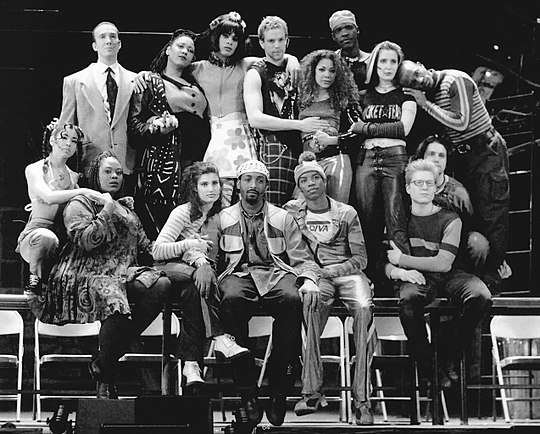
The 1996 cast of “Rent”

After a series of private, closed, and open readings, you will probably be anxious to see your musical on stage. Before you rush to book a theater, though, it’s a good idea (creatively and financially) to take one more step — and do a workshop instead of a full production. A workshop is a staged performance, but one with modest production elements. For example, a workshop may not have costumes, sets, or even a full musical accompaniment.

The primary purpose of a workshop is to refine your show based on a wider sampling of audience reaction than any reading allows. Only with an audience can you know what’s landing and what’s failing. “It’s all about figuring out what people are getting,” playwright Richard Greenberg said. “You get in front of a bunch of strangers, and you can hear when something is mystifying.”

Since workshops cost less than full productions, smaller companies (including community and youth theaters) are good places to consider sending your script. That’s how Rent began. In 1992, Jonathan Larson sent a tape and script to New York Theatre Workshop, which gave the musical a staged reading the following year. After that, Larson trimmed and simplified the complex plot, and NYTW produced another workshop in 1994. Larson continued to work on Rent through two more workshops, before NYTW gave the show a full Off-Broadway production in 1996.

You can also produce your own workshop in a cabaret room or community hall. It’s a lot more work, but that’s what Danny Goggin did with Nunsense, which opened for a four-day run at The Duplex, a Greenwich Village cabaret theater, and stayed for almost a year. Encouraged, Goggin expanded his revue into a full-length musical that ran Off-Broadway for ten years, becoming the second-longest running Off-Broadway show in history.

For more about self-producing, read Producing Your Own Showcase (2001) by playwright Paul Harris. For another developmental success story, read about the making of A Chorus Line in the book The Longest Line (2000) by Gary Stevens. For a developmental cautionary tale, read about the missteps of Song of Spider-Man (2013), written by Spider-Man: Turn Off the Dark librettist Glen Berger.

Once you are offered a full production, your work isn’t done, though. As you receive feedback about the songs, scenes, and more in rehearsal, you should make rewrites to resolve important questions. Even during preview performances, continue to make needed rewrites. In professional theaters, previews are as much as part of the creative process as closed readings — and it’s not just the script that changes daily, but also everything from costumes to lights.

In her 1978 autobiography, actor Ethel Merman described the process of daily changes. “They never stopped trying to add a joke, tidy up an exit, improve a punch line. I went along with the tinkering until the Thursday before our New York opening, when the show was supposed to be frozen — meaning no more changes. Still they continued making a change here and there until I faced them down, saying, ‘Boys, as of right now, I am Miss Birdseye of 1950. I am frozen. Not a comma!’”

For an overview of readings, rehearsals, and more, read Working on a New Play (1988) by Edward M. Cohen. For advice on the production process, read playwright Stephen Spotswood’s essay on how be a writer in the rehearsal room. For a look behind the curtain, watch The Band Wagon (1953) or the TV series Smash (2012). Below is a clip from the Smash episode “Let’s Be Bad,” showing an example of what not to do in rehearsal.

Next, where to send your work.

Posted in Writing | Tagged , , , , , , , , , , , | Leave a comment