Glee Recap: Dance with Somebody

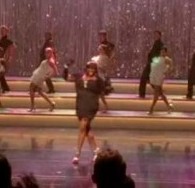
Heather Morris in "I Wanna Dance with Somebody"

“Dance with Somebody,” directed by Paris Barclay and written by Ross Maxwell, is the quickly assembled tribute to Whitney Houston, who died a little over 10 weeks ago. The first of seven songs heard from Whitney’s catalog is “How Will I Know,” sung by Mercedes (Amber Riley), Rachel (Lea Michele), Kurt (Chris Colfer), and Santana (Naya Rivera). They begin at their lockers and then continue to the library, when we suddenly cut to the quartet onstage in individual spotlights for the rest of the number. Huh?

Why are they singing about “a boy I know” while clutching Whitney’s photo? Is this supposed to be simultaneous inner monologues? If so, why does Will (Matthew Morrison) overhear them? If not, why doesn’t anyone else seem to hear them? And why were they singing in the library? In contrast with Smash, which clearly distinguishes its realities, Glee still has no rules after three seasons.

Darren Criss in "It's Not Right, But It's OK"

“It’s Not Right, But It’s OK,” sung by Blaine (Darren Criss), is another song that – while well performed – also defies logic. We begin with Blaine singing in the choir room, cut to a music video with him and four leather-clad backup dancers, cut back to the choir room with his classmates now singing along – and then we get a mashup of music video and classroom realities. What the heck? Why are the classmates not in leather too? Why do they keep disappearing in front of the video’s strobe lights? What have they done with Kurt?

A slightly more straightforward number is “I Wanna Dance with Somebody,” which is well performed by Santana and Brittany (Heather Morris), who also shines in the dance sequences.

The purpose of the episode, though, is not just to hear Whitney songs. Will asks New Directions to choose their songs as a way not only to address their grief about Whitney’s death but also to work through their anxiety about graduation and the losses that will entail. However, the show avoids exploring these emotions in any detail, in favor of the usual gift-wrapped endings. For example, in response to Blaine’s musical accusation, Kurt offers “I Have Nothing,” which quickly brings Blaine to tears. Next, we see Emma (Jayma Mays) counseling the couple, which of course ends with the two of them back in each other’s arms by the commercial break.

The episode ends with Mercedes and Artie (Kevin McHale) singing “Your Love Is My Love,” eventually joined by all the gleeks, as Will watches from the wings – the gift-wrapped moment for his slightly creepy and insane storyline.
Posted in Shows, TV | Tagged , , | Leave a comment

Nice Work: Review Roundup

Nice Work

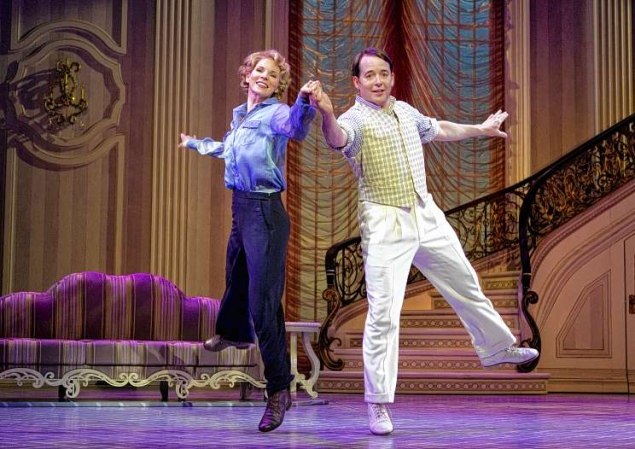
Kelli O'Hara and Matthew Broderick in Nice Work

The reviews for Nice Work If You Can Get It, the Gershwin pastiche musical inspired by Oh, Kay!, have been mixed but more favorable than not. Below is a sampling. For the record, the creative team is Joe DiPietro (book), Ira Gershwin (lyrics), George Gershwin (music), Kathleen Marshall (direction and choreography), Derek McLane (sets), Martin Pakledinaz (costumes), Peter Kaczorowski (lights), Brian Ronan (sound), Paul Huntley (hair), Angelina Avallone (makeup), Alexander V. Nichols (projections).

The cast includes Matthew Broderick (Jimmy), Kelli O’Hara (Billie), Michael McGrath (Cookie), Jennifer Laura Thompson (Eileen), Chris Sullivan (Duke), Robyn Hurder (Jeannie), Stanley Wayne Mathis (Chief Berry), and Judy Kaye (Duchess).

Ben Brantley (New York Times): Every now and then, a bubble of pure, tickling charm rises from the artificial froth. … [Most] registers as a shiny, dutiful trickle of jokes and dance numbers performed by talented people who don’t entirely connect with the whimsy of a bygone genre. But then, all at once, there’s a moment of delicate ridiculousness, of utterly credible improbability. … You feel the ache of knowing that they could be so much more. … The alchemy that could elicit magic from these promising ingredients is only fitfully in evidence.

Joe Dziemianowicz (Daily News): A light-hearted romp, but unfortunately, it’s not as intoxicating as you’d hope. Yes, star turns by Matthew Broderick and Kelli O’Hara give you a buzz. Ditto the classic George and Ira Gershwin showtunes, even though many of the songs are shoehorned in. If the show was all-singing and dancing, it could get by on charm alone. But the story by Joe DiPietro (Memphis), which closely mimics 1920s musicals, is a rusty antique knockoff, that sobers you up faster than a cup of black coffee. Why spend so much energy making something new that’s already old?

David Rooney (Hollywood Reporter): Having scored a huge success last season with Cole Porter’s 1934 musical Anything Goes, director-choreographer Kathleen Marshall follows by time-traveling back to the previous decade and dipping into the songbook of George and Ira Gershwin. The results are diverting, even if they don’t quite match the effervescence of that last excursion. Broderick is winningly paired with the luminous Kelli O’Hara (South Pacific), and the leads are backed by a string of top-notch character turns. … For Gershwin fans, Nice Work will be intoxication enough.

Howard Shapiro (Philadelphia Inquirer): Every detail in Nice Work If You Can Get It is finely tuned and beautifully turned out. … And the cast is spot-on. Is there any ingenue role in musical theater that Kelli O’Hara … couldn’t make her very own? In Nice Work, even given a stellar cast, when she’s on the stage she often is the single focus, by sheer force of her ability to sing any song fully in character, and deliver it with a striking musicality. … Nice work, for sure — and we get it, indeed.

Posted in Broadway, Shows | Tagged , , , , , , , , , , , , , | Leave a comment

Smash Recap: Publicity

Megan Hilty

Megan Hilty in "Second-hand White Baby Grand"

“Publicity” marked the return of pilot episode writer Theresa Rebeck and director Michael Mayer, and it was one of the best episodes since the pilot. Of course, much of Smash still doesn’t make sense – Iowa-fresh Karen (Katharine McPhee) remains incredibly fresh, schemer Ellis (Jaime Cepero) maintains an eerie sense of timing, and librettist Julia’s (Debra Messing) family continues an inexplicable shell game of living arrangements (this week her husband was back but her son was gone).

The main development last night was that our diva Rebecca (Uma Thurman) discovers she not only has to contend with three Marilyn shadows in Bombshell but two shadows in real life as well. Thanks to Ellis, Rebecca learns about director Derek’s (Jack Davenport) not-so-secret tête-à-tête with Karen, whom Rebecca sets out to kill with kindness. First stop, an A-list nightclub where Karen sings a Leona Lewis-light version of Snow Patrol’s “Run.” I’m still not a fan of McPhee’s doe-eyed acting, but I appreciated the choice of the song to foreshadow Karen’s problems with boyfriend Dev (Raza Jaffrey).
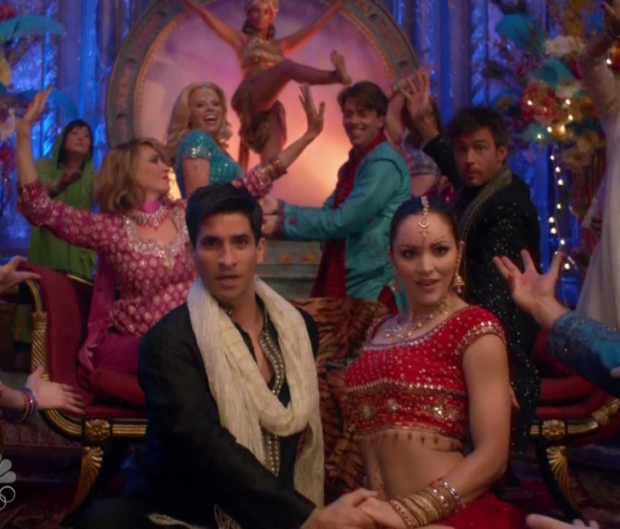
Raza Jaffrey and Katharine McPhee in "A Thousand and One Nights"

A few nights later, Rebecca and Dev meet, but the evening quickly devolves into cultural warfare, and we see Kat’s doe eyes glaze over as she conjures the Bollywood fantasy “A Thousand and One Nights,” which is completely ridiculous and thoroughly enjoyable. Jaffrey, who starred in Bombay Dreams, and McPhee sound and look great in this biggest production number the show has done so far. The entire cast ­is given cameos, even Linda (the under-utilized Ann Harada), but the best moment was Ellis stealing jewels from Eileen (Anjelica Huston). The number also serves to further question Karen and Dev’s relationship (“Is tonight the last or does the future hold a lifetime of delights?”).
It isn’t until the end of the episode that we see Rebecca fully appreciate the challenge from Ivy (Megan Hilty), watching her sing “Secondhand White Baby Grand,” a beautiful Broadway ballad from songwriters Marc Shaiman and Scott Wittman. While historically accurate to Marilyn Monroe’s biography, the song also serves as a perfect personal statement for Ivy (“I still have something beautiful to give.”), and Hilty performs the heck out of it – musically and emotionally.

Posted in Shows, TV | Tagged , , , | Leave a comment

Ghost: Review Roundup

The reviews for Ghost: The Musical, adapted from the 1990 film, have been almost unanimously negative so far. Below is a sampling. For the record, the Ghost creative team is Bruce Joel Rubin (book and lyrics), Dave Stewart and Glen Ballard (lyrics and music), Matthew Warchus (direction), Ashley Wallen (choreography), Rob Howell (sets), Rob Howell (costumes), Hugh Vanstone (lights), Bobby Aitken (sound), Campbell Young (hair and makeup), Jon Driscoll (projections), and Jon Driscoll (video). The cast includes Richard Fleeshman (Sam), Caissie Levy (Molly), Da’Vine Joy Randolph (Oda Mae), and Bryce Pinkham (Carl).
Terry Teachout (Wall Street Journal): The musical version of Ghost … belongs not on Broadway but in the Smithsonian Institution. Not only would such a transfer free up a valuable piece of real estate, but it might also help historians of the future to understand what went wrong with the Broadway musical in the 21st century.

Elysa Gardner (USA Today): The score … veers from such tunes to hard arena-rock candy, throwing in a few touchy-feely ballads for the grieving Molly. But the lyrics …  are more likely to make you laugh than cry. During the aforementioned production number, a ghost croons to Sam, “There’s a tag on your toe now/You’re cold now/You died.”

Charles Isherwood (New York Times): Ghost … may not be the very worst musical ever made from a movie … but it is just as flavorless and lacking in dramatic vitality as many that have come before. … High-tech flourishes lend the show the feel of one of those sensory-bath, movie-inspired rides at the Universal Studios and Disney theme parks. But the thrill is fairly minimal.

Suzy Evans (Back Stage): Exactly what is wrong with Ghost: It’s trying to be something it’s not. Warchus has turned a touching silver-screen love story into an overly flashy showbiz musical that betrays the intimacy of its source. … Because book writer and co-lyricist Bruce Joel Rubin’s scene-for-scene re-creation of his Oscar-winning script matches it almost too perfectly, the cast is essentially asked to mimic the film.

Posted in Broadway, Shows | Tagged , , , , , , , , | Leave a comment

Hard Knock Life

In yesterday’s post for Salon, journalist Scott Timberg explores why there is “No Sympathy for the Creative Class.” He writes, “There’s a sense that manufacturing, or the agrarian economy, is what this country is really about. But culture was, for a while, what America did best: We produce and export creativity around the world. So why aren’t we lamenting the plight of its practitioners?”

He highlights several statistics to show just how badly the press and media have missed this story, beginning with figures from the Bureau of Labor Statistics, which show that performing arts jobs are down 21.9 percent over the past five years, and from Kickstarter, which on the whole has been a help but not a panacea, since the crowd-funding site accepts just 60 percent of all proposals, with only about 43 percent of those ending up being supported.

Timberg proposes several answers to his question, from the widely held subjective belief that creative types “are supposed to struggle” to the unfortunate objective fact that newspapers have laid off about 50 percent of their arts journalists. Along the way, he explores the effects of the populist anti-intellectualism in America – from the Puritans to Dan Quayle – and of the market fundamentalism in which everything “can be bought, sold and measured” and which trivializes the arts as mere souvenirs of “cultural tourism.”

It is a large question, and Timberg falls short of providing a large answer, but it is a welcome opening in the conversation and an important acknowledgment of the problems facing a vtial segment of America’s working middle class.

Posted in Business, Performing | Tagged , , , , | Comments Off on Hard Knock Life

All Good Gifts

In Broadway’s Golden Age, producers would hold backers’ auditions to raise funds. For example, librettist Arthur Laurents remembered how Cheryl Crawford organized an event for West Side Story investors at “an apartment on the East Side [where] there was no air conditioning and you could hear the tugboats. She didn’t raise one penny.” If repeated auditions proved unsuccessful, some producers resorted to making cold calls from the phonebook, as lampooned in The Producers, until lawmakers intervened.

Today, such “angels” tend to be “accredited” investors of significant net worth. As defined in Rule 501 of Regulation D of the Securities Act of 1933, this means someone worth over $1 million or who has earned over $200,000 for the past two years. The presumption is that such individuals are financially sophisticated – they know that about three-quarters of all shows don’t recoup their investments – and they can afford to take a $50,000 tax write-off.

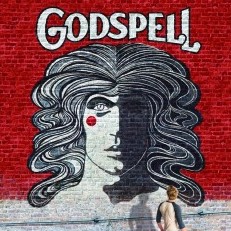
The New York Times reported on a new model, new at least for commercial theater. The recent Broadway revival of Godspell received more than half of its $5 million capitalization through crowd-funding from a group of about 700 investors, who donated as little as $1,000 each. In return, shareholders get regular e-mail updates, webinars, discount offers, and more. Lead producer Ken Davenport said he was inspired by the success of Obama’s 2008 campaign and by Kickstarter. Launched in 2009, the crowd-funding website has made significant progress in the past two years. In 2011, there were 50,144 backers who pledged $4,051,962.62 through Kickstarter for 931 theater projects that cost from $1,000 to $50,000.
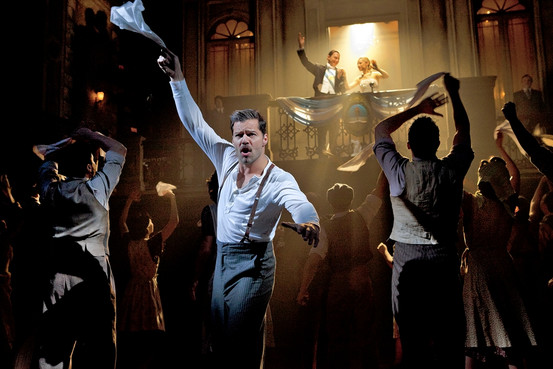
In tandem with widening investor participation, Godspell has also taken a cue from nonprofit theaters and offered an 11-week talkback series this winter, aired on Sirius XM On Broadway channel. If Davenport is successful in recouping the show’s investment, expect to see more of his hybrid model.

Posted in Business, Producing | Tagged , , | Leave a comment

Oh, What a Circus

Ricky Martin

On April 5, the first Broadway revival of Evita opened at the Marquis Theater, and the majority of ink and bits devoted to the show since then have not been on the overall production but on the specifics of its casting, in particular the casting of Ricky Martin as Che. Though celebrity casting is more common in replacement casts than in original casts, and though Martin is a bigger celebrity than say Mos Def, who gave a winning performance in Topdog/Underdog, I don’t understand the preoccupation ­– unless it’s schadenfreude.

Indeed, Martin has received mixed reviews at best – Ben Brantley called Martin “thin voiced, polite, vaguely charming and forgettable” – but it seems a weak foundation to extrapolate from one performance to an argument that most pop stars have “a straightforward, indicative performance style that has only a tangential relationship to stage acting,” as critic Alexis Soloski suggests. In response to Soloski’s post, director Scott Miller wrote that the argument shouldn’t be about pop stars, or even celebrities, but “the considerable difference between performing and acting.” In what may be considered heresy, Miller also believes, “Patti LuPone and Mandy Patinkin are performers more than actors.”

Though I don’t agree with his opinion of Evita’s original cast – which he seems to base on a singular TV clip and not the live production, which I remember fondly – I do agree with him that “People come to musicals for the emotion, so to give them fake emotions for their money is fraud. And it’s a fraud perpetrated so widely, especially in commercial musical theater, that audiences generally accept it without complaint. Or they think musicals are just inherently shallow and phony. Which they’re not.” However, that is assuming we’re talking about “book musicals” like Evita and about the protagonists of those musicals, because there are some shows and some roles that demand to be performances.

As Fred Ebb said, “Give ’em an act with lots of flash in it, and the reaction will be passionate.” Of course, he also said, “Long as you keep ’em way off balance, how can they spot you got no talents?”

Posted in Business, Performing | Tagged , , | Leave a comment

Glee Recap: Saturday Night Glee-ver

In the recent New Yorker, Adam Gopnick comments on “The Forty-Year Itch,” that “prime site of nostalgia” invoked by 40-something Hollywood suits fascinated by “the Edenic period preceding the fallen state” of their lives. Last night’s episode of Glee is a textbook example from 46-year-old series creator Ryan Murphy. “Saturday Night Glee-ver,” written by veteran gleek Matthew Hodgson, is the second film tribute of the series; the first honored the iconic 1970s movie The Rocky Horror Picture Show. In contrast to Smash, there is a surfeit of music here, and last night’s episode covered nearly the entire Saturday Night Fever soundtrack.

Alex Newell in
"Boogie Shoes"

The standout number was “Boogie Shoes,” led by Wade (Alex Newell, runner-up on The Glee Project). As with most disco songs, the lyrics are little more than musical foreplay, but Newell transforms the song into a statement of personal strength akin to “I Will Survive.” The other performances in the show paled in comparison. Director Bradley Buecker over-compensated for the static “How Deep Is Your Love” from Rachel (Lea Michele) and “More Than a Woman” from Finn (Cory Monteith) by constantly panning the camera, while “If I Can’t Have You” from Santana (Naya Rivera) and the “Stayin’ Alive” finale from the cast came off as bland as their white polyester. The songs sounded authentic – perhaps too much authentic falsetto – but the characters never owned them.

In television, most numbers are “program songs” inserted into the story. In theater, most numbers are “character songs” that arise from the story. It’s the classic dichotomy between Dionysian show-stopping razzle-dazzle and Apollonian dramatic progression. Some numbers are a fusion of both, though. For example, “Wilkommen” from Cabaret and “So Long, Farewell” from The Sound of Music are program songs, that is, songs presented as performed songs, that also provide insight into their characters or the themes of their shows.
What allowed “Boogie Shoes” to work as a show-stopping song and a plot song was its connection to its character and, subsequently, to his story. A telling example of the desire but failure to do the same with “If I Can’t Have You” was Santana’s explanation of her performance immediately afterward. If the number had been able to serve as a character song, such a bald explanation of its plot and subplot elements would be unnecessary; however, the number’s fatal flaw was that it had no razzle and little dazzle.

Posted in Shows, TV | Tagged , , | Leave a comment

Smash Recap: The Movie Star

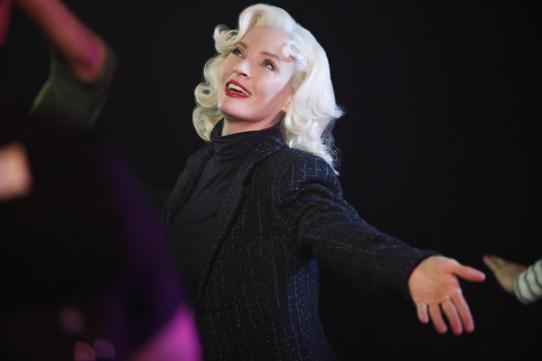
Uma Thurman in "Dig Deep"

Finally, in Episode 11, we meet Rebecca Duvall (Uma Thurman) – the cameo last week being little more than a publicity teaser ­– and as too often happens with marquee names, the star of Bombshell has the wattage but not the pipes. Of course, from Rex Harrison to Zero Mostel, from Thelma Ritter to Lauren Bacall, many stars who were not able to sing opera, as Eileen (Anjelica Huston) quips, were able to deliver Tony-winning musical performances.

Thurman was delightfully inept in the episode’s opener, a short reprise of “Let Me Be Your Star,” and acquitted herself nicely in the closing number, “Dig Deep,” the one original song from Marc Shaiman and Scott Wittman, which was winningly choreographed by Joshua Bergasse if somewhat frenetically directed by Tricia Brock. Unfortunately, the closer and an unconvincing interpolation of “Our Day Will Come” were all the music we got in the show ­– the most parsimonious episode yet.

It seems writers Julie Rottenberg and Elisa Zuritsky took Rebecca’s view of musicals too much to heart, since their script was thin on song and heavy on plot. They did offer some fun repartee and ready-made catchphrases like “Dial it down” and “Buckle up.” There also was an interesting deepening of the frenemy relationship between Karen (Katharine McPhee) and Ivy (Megan Hilty) and the welcome comeuppance that Ellis (Jaime Cepero) received from Randall (Sean Dugan). However, there were more than a few odd moments, including Rebecca’s boyfriend bursting into the rehearsal room and the Houston family neatly resolving their son’s academic crisis.

If the series continues to waver, it could veer from the strong course set in its pilot. The characters are beginning to sound like soap actors more often than real theater people, the energy of the original music is becoming deflated by the interpolated songs, and the visual in-jokes of the art direction are being offset by unusual location choices – does the Brill Building even have rehearsal studios that could accommodate Broadway musicals?

As Sam (Leslie Odom Jr.) tells Tom (Christian Borle), “Please don’t ever do that again. … Seriously.”

Posted in Shows, TV | Tagged , , , | Leave a comment