Ghost Brothers: Review Roundup

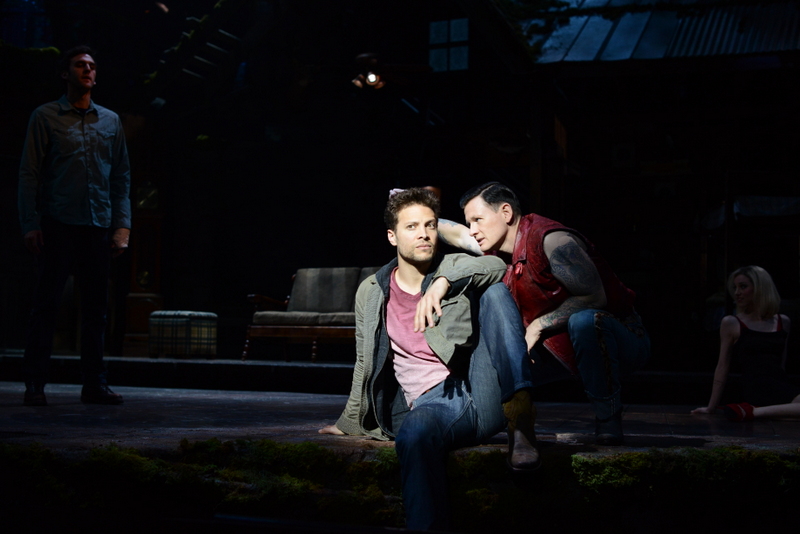
Justin Guarini and Jake La Botz in Ghost Brothers

Reviews for Ghost Brothers of Darkland County, which received its world premiere at Alliance Theater in Atlanta, have been mixed but leaning negative. For the record, the creative team is Stephen King (book), John Mellencamp (lyrics and music), T Bone Burnett (music direction), Susan V. Booth (direction), Daniel Pelzig (choreography), Todd Rosenthal (sets), Susan E. Mickey (costumes), Robert Wierzel (lights), Clay Benning (sound), and Adam Larsen (projections). The cast includes Peter Albrink (Jack), Kylie Brown (Anna), Kate Ferber (Jenna), Justin Guarini (Drake), Shuler Hensley (Joe), Joe Jung (Newt), Lucas Kavner (Frank), Jake La Botz (The Shape), Royce Mann (Young Joe), Christopher L. Morgan (Dan), Emily Skinner (Monique), and Travis Smith (Andy).

Jim Farmer (Arts Atlanta): Moments of jagged brilliance, and some superb music, but it’s quite a way removed from being polished. … It’s basically thin material, stretched well past two hours. … Musically, however, Ghost Brothers has some stirring moments. … Despite the occasional good song, the show feels flat. While Mellencamp’s rock sensibility is all over it, there doesn’t seem to be much of King’s. … Few world premieres get it all right the first time. With some tightening and first-act restructuring, the ambitious Ghost Brothers of Darkland County holds exceptional promise. Die-hard Mellencamp and King fans will probably want to see it for the spectacle, but it’s not yet quite where it needs to be.

Manning Harris (Atlanta Intown): As a mesmerizing spectacle, Ghost Brothers dazzles. … The music! A rockin’ bluesy good score, expertly performed. Kudos to Mr. Mellencamp and Mr. Burnett. True, the songs don’t really drive the story forward; they comment on the action. Mr. Mellencamp said that was his aim. He succeeded. … It’s not really clear, compelling, character-driven theatre yet, but what brand new show doesn’t need a few tweaks? Ghost Brothers of Darkland County is expertly sung and acted. … Is it Broadway bound? All the creators say they don’t care, but I don’t believe them. Who knows? The main thing is it’s here now: carpe diem.

Frank Rizzo (Variety): The pairing of roots rocker John Mellencamp and horror scribe Stephen King for a Southern Gothic musical may sound irresistible. But it takes more than a groove and gore to make this tedious tale of brotherly bile work on stage. Sketchy character development, awkward staging and unclear storytelling make prospects for future life iffy beyond this world preem at Atlanta’s Alliance Theater. … Mellencamp’s songs either provide character comment, action accompaniment or honkytonk atmosphere, and while giving the show some percussive power, they rarely lift the proceedings emotionally. … But the principal weakness is King’s unfocused storytelling.

Jason Zinoman (New York Times): Developed over many years by famous musical-theater novices, this sprawling show … stitches together dynamic elements that never satisfyingly cohere. It has the feel of something devised over Skype. Fans of Mr. King and Mr. Mellencamp will, however, find much of interest, since you can hear their unmistakable voices. … The songs don’t move the story along so much as illuminate character. Too often they slow down Mr. King’s tale, when not actively distracting you from it with lyrics that tell more than show. … For a delicate, collaborative form like the musical, a simpler, streamlined narrative might have made more sense. Ghost Brothers brings to mind a suitably violent writer’s truism: Sometimes you have to kill your babies.
Posted in Regional US, Shows | Tagged , , , , | Leave a comment

And the Nominees Are …

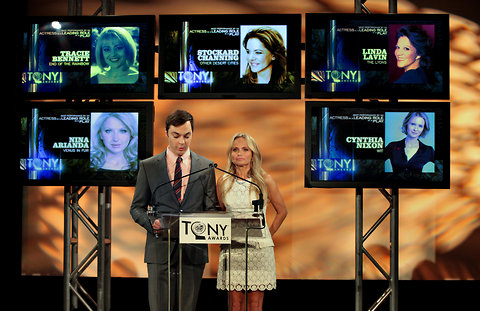
Jim Parsons and Kristin Chenoweth

On Tuesday, Kristin Chenoweth and Jim Parsons presented this year’s Tony roster, the final list of award nominations for the 2011/12 New York season. This coming Sunday, the Off-Broadway League will announce the first of this season’s winners, when it presents its Lucille Lortel Awards.

The favorite Broadway musicals of the season include Newsies and Nice Work If You Can Get It and the revivals of Follies and Porgy and Bess. The favorites Off-Broadway include Death Takes a Holiday, Queen of the Mist, and the short-lived revival of Carrie. However, the most lauded musical of the season is Once, which garnered nominations for both its Off-Broadway run and its Broadway transfer this season.

Once received nominations a Best Musical not only for the Lortel and Tony awards but also for the Drama Desk, Outer Critics Circle, Drama League, and Off-Broadway Alliance honors. The musical garnered an additional 26 noms in total from the six organizations – 32 in all – with four of them for director John Tiffany and three apiece for choreographer Steven Hoggett, set designer Bob Crowley, sound designer Clive Goodwin, and actress Cristin Milioti.

In the Off-Broadway races, Queen of the Mist tied Once with five noms as Best Musical, with The Blue Flower, Death Takes a Holiday, and Silence receiving two apiece. For Best Revival, Carrie leads with four noms. Among actors, Marin Mazzie is out in front with three noms for her role in Carrie, while her co-star Molly Ranson follows closely with two. The frontrunners for Best Score are Maury Yeston’s Death Takes a Holiday and Michael John LaChiusa’s Queen of the Mist, which each received two noms. The only other Off-Broadway multiple nominee is costume designer Catherine Zuber for Death Takes a Holiday.

In the Broadway races, Newsies leads with four noms as Best Musical, while Leap of Faith and Nice Work have three apiece and Bonnie & Clyde has two. Among revivals, Evita, Follies and Porgy and Bess each received four noms as best of the season, while Jesus Christ Superstar received three. The frontrunners for Best Score, both with three noms, are Alan Menken and Jack Feldman’s Newsies and Frank Wildhorn and Don Black’s Bonnie & Clyde.

The favorite leading actors include Danny Burstein and Jan Maxwell from Follies, Jeremy Jordan from Newsies, Kelli O’Hara from Nice Work, and Norm Lewis and Audra McDonald from Porgy and Bess, while among supporting actors, the leading contenders are Phillip Boykin from Porgy and Bess and Judy Kaye and Michael McGrath from Nice Work – each with three nominations apiece.

The choreography category is a toss up, with Rob Ashford of Evita, Christopher Gattelli of Newsies, and Kathleen Marshall of Nice Work each a triple nominee. Other multiple nominees, each with three noms as well, include costume designer Gregg Barnes of Follies and director Kathleen Marshall, librettist Joe DiPietro, and costume designer Martin Pakledinaz of Nice Work.

The winners will be announced May 6 for the Lortels, May 7 for the New York Drama Critics’ Circle, May 14 for the Outer Critics Circle, May 18 for the Drama League, May 21 for the Obies, May 22 for the Off-Broadway Alliance, June 3 for the Drama Desk, and finally June 10 for the Tony Awards.

Posted in Awards, Stage | Tagged , , , , | Leave a comment

Glee Recap: Choke

After two weeks of tribute shows, this week’s episode of Glee was thankfully unencumbered by retrofitted catalog songs, and it was refreshing to hear the nice balance of Broadway and pop songs that director Michael Uppendahl smoothly juggled amid the three story threads that writer Marti Noxon had concisely weaved.

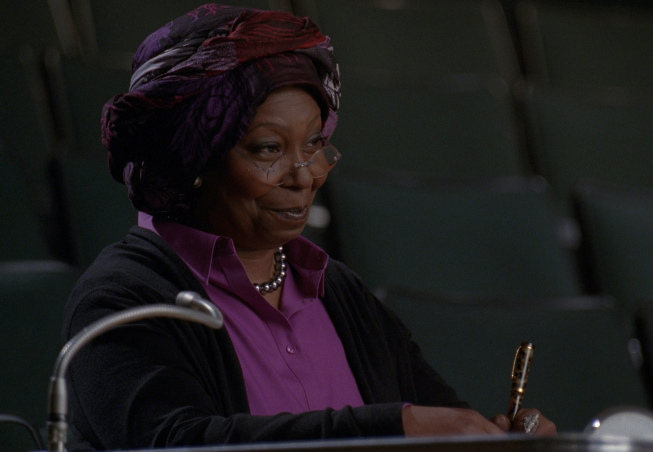
Whoopi Goldberg

The storyline we’d been expecting was the NYADA audition, for which Rachel (Lea Michele) and Kurt (Chris Colfer) had been preparing for the past seven weeks. Of course, Rachel was born to be Fanny Brice, so she spent most of her time fine tuning her affirmations rather than rehearsing. Kurt however was torn, preparing lavish presentations of both “Music of the Night” from The Phantom of the Opera (his safe choice) and “Not the Boy Next Door” from The Boy from Oz (his risky choice).

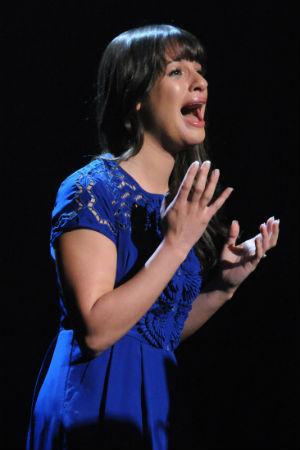
Lea Michele in "Cry"

When Kurt learns the audition judge is NYADA school dean Carmen Tibideuax (Whoopi Goldberg), he goes with his gut to take the risk and nails the performance. Rachel though chokes under the pressure and blanks on the lyrics to her signature song, “Don’t Rain on My Parade” from Funny Girl. I didn’t see that coming, and it was nicely handled by Michele, who later gave a gut-wrenching cover of Kelly Clarkson’s “Cry,” one of the episode’s and the season’s highlights.

Another expected storyline was Puck’s (Mark Salling) struggles to graduate, which he tried to ignore with a kinetic but bland cover of Alice Cooper’s “School’s Out.” What was unexpected was the appearance of his father (Thomas Calabro), which gave Puck the 11th-hour incentive to study. The cramming session provided the lead-in to a punk version of “The Rain in Spain” from My Fair Lady, a surprising and fun choice that was given an overlong and repetitive performance.

Completely out of left field was the storyline about domestic abuse. Roz (NeNe Leakes) happens to overhear the girls ­ – Tina (Jenna Ushkowitz), Santana (Naya Rivera), Mercedes (Amber Riley), Brittany (Heather Morris), and Sugar (Vanessa Lengies) – speculating about Coach Beiste’s (Dot-Marie Jones) black eye. Roz reports them to Sue (Jane Lynch), who gives them a musical assignment as detention. The girls first choose the inappropriate, though well performed, “Cellblock Tango” from Chicago. Their second and more appropriate choice, Florence Welch’s “Shake It Out,” provided another episode and season standout.
Posted in Shows, TV | Tagged , , | Leave a comment

Smash Recap: Tech

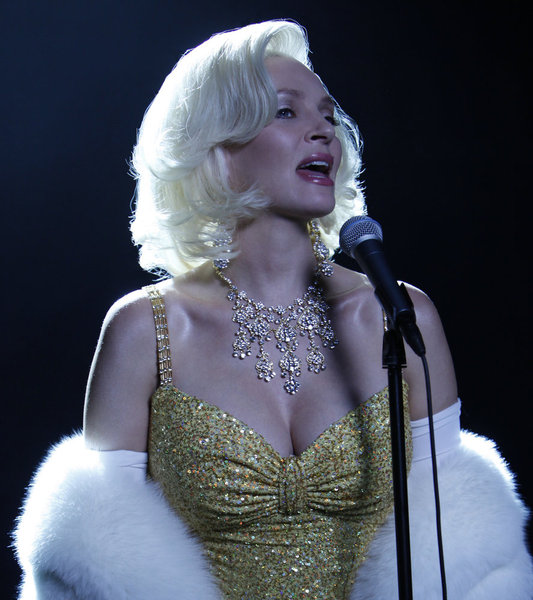
Uma Thurman in
"Happy Birthday"

I have a love-hate relationship with Smash. And this week it’s hate. It’s perverse that a show about a Broadway musical continues to shy away from Broadway music – and some weeks, any type of music. Last night’s episode was musically slimmer than the anorexic episode two weeks ago. This week, “Tech” gave us no new original songs, just three cover songs – including a Marilyn Monroe “Happy Birthday” sung by Rebecca (Uma Thurman), which we’ve heard Karen (Katharine McPhee) sing in two other episodes – and a short reprise of “History Is Made at Night,” which we’ve heard in three other episodes.

We were thrown a small bone: as underscoring for the establishing shots of Bombshell moving into its out-of-town home in Boston (which the cast seems to have traveled to from Platform 9¾ at Grand Central Station), we heard the cliché “Another Op’nin’, Another Show” sung by Tom (Christian Borle) and Sam (Leslie Odom Jr.). The men delivered the song well enough, but no matter how dressed up the musical arrangement, the choice of that song only begged comparison with Cole Porter’s superior backstage musical – for those who don’t know (and if you don’t, why are you watching Smash?), that’s Kiss Me, Kate. Rent it and compare.

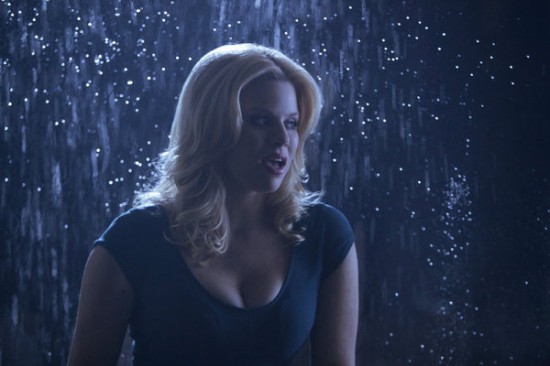
Megan Hilty in
"I'm Going Down"

Ivy (Megan Hilty) sang the only other song, “I’m Going Down,” originally written by Norman Jesse Whitfield for the prostitute in the 1977 film Car Wash. Hilty was wonderful as usual, but the song felt shoehorned into the storyline. I mean, really, a sing-off? Do Broadway gypsies have sing-offs … two days before an opening night out of town … after a week of tech … while preparing for a major cast replacement … and rehearsing rewrites all day? We don’t even get to hear Karen in the competition anyway, because her boyfriend Dev (Raza Jaffrey) just happens to be wandering the hall and just happens to see her, because the cast just happens to leave the door to the hotel room ajar – perhaps as an invitation to all the other hotel guests to join the party? Oy.

And where was “Stand,” Donnie McClurkin’s 1996 gospel song, which Karen and Sam were supposed to sing? It’s not a new song either, but at least it would have been another musical moment and may have provided some emotional meat instead of the melodramatic gristle we were served on this episode’s plate.  Speaking of melodrama, Julia’s (Debra Messing) family have agreed to accompany her to Boston, because they have the time anyway since it’s spring break – which is where I guess Smash songwriters Marc Shaiman and Scott Wittman have been the past week.

What is unique about Smash is its milieu – and its music. Glee may be formulaic and thin, but at least we get a bunch of tunes each week, even if they aren’t original. The airwaves don’t need another soap opera, but I fear that’s what Smash will become, particularly since NBC has announced they are replacing creator Theresa Rebeck as show runner with Joshua Safran from Gossip Girl. If Smash does devolve into who slept with whom, I may not tune in for Season 2.

I’m already wary of how the show will deal with the obligatory smoking peanut that puts Rebecca into anaphylactic shock and with the coincidental rebound hookup of Ivy and Dev, who seems to have gotten around Boston quicker in one day than Paul Revere did. But as a true Broadway baby, I will look on the bright side of life and believe the sun will come out tomorrow.

Posted in Shows, TV | Tagged , , , , | Leave a comment

Fat Camp: Review Roundup

Fat Camp

Carly Jibson and Molly Hager in Fat Camp

Reviews for the new Off-Broadway musical Fat Camp, originally presented at the 2009 NYMF, were mixed but generally favorable. Below is a sampling. For the record, the creative team is Randy Blair (book and lyrics), Tim Drucker (book), Matthew roi Berger (music), Casey Hushion (direction), Kelly Devine (choreography), Beowulf Boritt (sets), David Woolard (costumes), Jason Lyons (lights), and Matt Kraus (sound). The cast includes Janet Dickinson (Sandy), Daniel Everidge (Robert), Molly Hager (Taylor), Carly Jibson (Daphne), Cale Krise (Anshel), Marcus Neville (Mike), Larry Owens (Darnell), Tracy Weller (Ashley), Kate Weber (Britta), and Jared Zirill (Brent).

Brian Scott Lipton (Theater Mania): The committed work of a troupe of truly talented young actors brings much needed heft to Fat Camp, an always amiable, periodically sparkling new musical. … Not a whole lot actually happens over two hours – romances are forged, lessons are learned, candy is eaten – as the cast digs in with gusto to the rock-infused score by Blair and composer Matthew roi Berger and execute Kelly Devine’s athletic-inspired choreography with consummate skill. … Everidge brings the necessary warmth and vulnerability to the role of Robert, while Hager is even better, nailing every moment and creating a complex characterization. Both actors have strong yet supple voices that come together nicely on duets. … Still and all, the show is completely stolen by the delicious Jibson … a truly gifted physical comedian and powerhouse vocalist.

Michael Musto (Village Voice): Fat Camp is a silly, exuberant musical that comes at you like an ice cream truck and doesn’t slow down. The situations in the show could be from any campy camp comedy – the jealousies, romances, one-upmanships, self-image problems, and triumphs. But the characters happen to be plus sized and are trying to be “losers” ­– some way more than others – as Camp Overton becomes a place where you can shed some inhibitions along with a pound or two, while singing and dancing up a storm. …. The show is lively and often clever … and the cast consists of of big-lunged belters who can also deliver laughs.

Matthew Murray (Talkin’ Broadway): Fat Camp is big fun … a devilishly tuneful and warmly entertaining evening that fills you up but doesn’t pack on the pounds. If it grows a bit svelte on ingenuity after intermission, it’s nonetheless an energetic, eclectic corrective for what was, all things considered, a lackluster spring for tuners on Broadway. … A few problems remain, mostly in the second act. …  When Fat Camp is at the top of its game, however, it’s a delight – and even something of a thoughtful one. Rare indeed is a musical about staying true to your own beliefs and maintaining a positive self-image that is enacted by performers who actually look like they possess the confidence of individuality they’re trying to inspire in others.

Keith Staskiewicz (Entertainment Weekly): There’s The plot here is secondary to Fat Camp’s cast of dedicated performers, who throw themselves into their roles with enough fervor to make up for the limited choreography and a few mumbled lyrics. Carly Jibson is hilarious as Daphne, a bell-shaped Southern belle whose only personal goal at camp is to have as much sex as possible. Writers Randy Blair and Tim Drucker (working with composer Matthew roi Berger) offer up quite a few good punchlines that don’t rely on easy fat jokes. … Like a sugar high, the effect of Fat Camp starts wearing off once you leave the theater. For a show about so much corpulence, it feels a bit slight.

Posted in Off-Broadway, Shows | Tagged , , | Leave a comment

Broadway Trifecta

Alan Menken

When Leap of Faith opened on April 26, composer Alan Menken joined the select group of writers that have had three original musicals running simultaneously on the Great White Way. Menken’s other two current shows are Newsies and Sister Act. Since Oklahoma!, this Broadway trifecta has only occurred about once a decade. Menken’s run will be one of the shortest, though, ending about four months from now, if Newsies closes as planned on August 19.*

The first trifecta in the modern era belongs to Richard Rodgers and Oscar Hammerstein II, whose run lasted about seven and a half months in the early 1950s, from the May 28, 1953 opening of Me and Juliet at the Majestic Theatre to the January 16, 1954 closing of South Pacific, which had transferred to the Broadway Theatre to accommodate the new show. Their third show was The King and I, which ran at the St. James, across the street from the Majestic. In the late 1960s, Jerry Herman scored a brief trifecta with the four-month run of Dear World, from February 6 to May 31, 1969. His other two shows on the boards at the time were Hello, Dolly! and Mame, which Angela Lansbury left to star in Dear World.

Stephen Schwartz had one of the longest trifectas, about one year in the mid-1970s, from the opening of Godspell on June 22, 1976 to the closing of Pippin on June 12, 1977. His third musical at the time was The Magic Show. Andrew Lloyd Webber scored a run of 11 months in the early 1980s, from October 7, 1982, when Cats opened at the Winter Garden for its historic run, until Joseph and the Amazing Technicolor Dreamcoat closed on September 4, 1983. His other show was Evita, running at the Broadway Theatre, across the street from Cats.

Frank Wildhorn had one of the shortest trifectas, with the two-month engagement of The Civil War from April 22 to June 13, 1999. Wildhorn’s other two shows in their first run were Jekyll & Hyde and The Scarlet Pimpernel. The longest trifecta, at four years and five months, belongs to Tim Rice. During the entire run of Aida – March 23, 2000 to September, 5, 2004 – Rice was also represented on Broadway with Beauty and the Beast and The Lion King.

The shortest trifecta goes to bookwriter and lyricist Michael Stewart, who contributed material to three shows that were simultaneously on Broadway for three days. In March 1981, Stewart’s work included Barnum, 42nd Street and Bring Back Birdie, which had a total of 31 previews and four performances.
*Newsies later announced an open-ended run, but Menken’s trifecta ended earlier than expected, when Leap of Faith closed May 13, after only 20 performances.

Posted in People, Writers | Tagged , , , , , , , , | Leave a comment

Bonnie & Clyde: Album Reviews

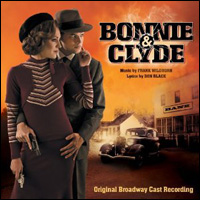
Recorded on January 2, 2012, just three days after its closing night, the Original Broadway Cast album of Bonnie and Clyde was released in stores last week by Broadway Records. The score had received warmer reviews than the production. Below is a sampling of reviews of the score and the album. For the record, the creative team includes Frank Wildhorn (music), Don Black (lyrics), Ivan Menchell (book), and John McDaniel (orchestrations and arrangements). The liner notes include essays from the creative team, as well as complete lyrics.
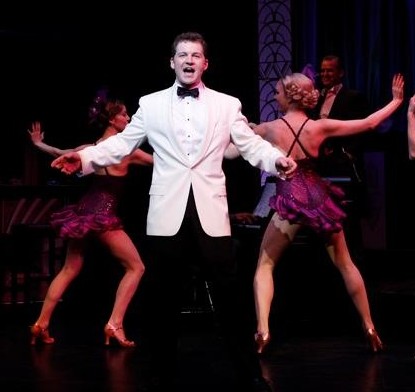
Andy Propst (Theater Mania): Frank Wildhorn’s blend of pop sounds, period tunes and Broadway bombast, along with Jeremy Jordan and Laura Osnes’ electrifying performances, are all grandly preserved. … Unfortunately, as the pair’s exploits become more violent and adrenaline-charged, Wildhorn’s score (which receives little help from Don Black’s lyrics) becomes increasingly eclectic. … Regardless, there’s no questioning the sheer vocal power and emotional intensity that Osnes and Jordan bring to the work. … Accompanying the disc, which also includes a bonus track of [“This Never Happened Before”] a gorgeous number cut from the show as it developed, is a stunning booklet filled with not only a plethora of color pictures from the Broadway production, but also some great black and white photos from the period. The synopsis and lyrics are also complemented by brief essays from Wildhorn, Black and McDaniel, and there’s even a reprint of one of Bonnie’s original poems.

Ben Brantley (New York Times): Mr. Wildhorn … is politely restrained for a production that you might have expected to bring out his most lurid side. His musical template is humbly of the people this time, which means a little bit gospel, a little bit ragtime, a little bit country-western. But the numbers – even the kind of evangelical call-and-response song that usually gets audiences whooping and clapping along – all seem to flat-line in the end. Tellingly the show’s best song is a slender, shimmering hymn to small and ordinary pleasures, nicely performed by Melissa van der Schyff.

Elysa Gardner (USA Today): Jeremy Jordan’s robust singing and graceful swagger just make the hollowness of Clyde’s narcissism – and of the generic vocal showcases that Black and Wildhorn provide him – more obvious. Wildhorn’s music is, as usual, more ingratiating than theatrically compelling. There are predictable nods to roots music of the era, with melodic and textural flourishes evoking everything from Duke Ellington to Bon Jovi. Some of the less bombastic tunes are mildly pleasing, but they do little to serve the arc of Bonnie and Clyde’s journey, or those of the characters surrounding them. Several gifted players tackle those roles, among them Melissa Van Der Schyff, whose limpid tone and sweetly trembling vibrato recall a young Dolly Parton.

Linda Winer (Newsday): The show has two of the elements that broad audiences seem to like in a musical: a recognizable story and music that sounds like music we’ve heard before. … This is Wildhorn’s most developed, most genuinely theatrical score. Unlike the prolific craftsman’s six critically unloved shows since 1995 … this one actually integrates its creamy middle-of-the-road songs with the storytelling in Ivan Menchell’s capable book. Too many numbers cancel one another out with big yowling climaxes … and, more than several times, I found myself asking “So what?” as the familiar saga unfolds with more forward-moving passion than subtle emotional content. But the story moves. The bluesy, country-kicking songs serve the characters. And the characters grow believably from their Depression-era hopelessness of the dust-poor Texas town.

Steven Suskin (Playbill): The phrase “Frank Wildhorn musical” has a certain connotation in some circles, but here the composer confounded at least some of his critics. The show … didn’t work; the music, though, wasn’t the problem. This was the best of the scores Wildhorn has given us, which might in itself not sound like much of a recommendation. But Wildhorn, here, actually seemed to be writing for the theater. Don Black’s lyrics, though, were not particularly helpful. … Fans of Wildhorn (of which there are many) and fans of Bonnie & Clyde (of which there are some) will be glad to add the posthumously recorded CD to their collection.

Posted in Albums, Books & Media, Original Stage Cast | Tagged , , , , , | Leave a comment

The City Club: Review Roundup

Andrew Pandaleon in
The City Club

The reviews for The City Club, a new Off-Broadway musical that opened at the Minetta Lane last week, have been primarily negative. For the record, the creative team is Glenn M. Stewart (book), James Compton, Tony Demeur and Tim Brown (lyrics and music), Mitchell Maxwell (direction), Lorin Latarro (choreography), Rob Bissinger (set), David C. Woolard (costumes), David F. Segal (lights), and Carl Casella (sound). The cast includes Kristen Martin (Crystal), Andrew Pandaleon (Chaz), Ana Hoffman (Maddy), Peter Bradbury (Lieutenant), and Kenny Brawner (Parker).

Elizabeth Ahlfors (Curtain Up): While much of the club’s music is buoyant, a problem arises from cramming as many film noir twists as possible into a relatively simple story. Even though this Off-Broadway version has been extended from the original Edinburgh production to 2 hours and 20 minutes, the show feels overstuffed and the characters are skimpy. … Mitchell Maxwell keeps a quick pace for the show but the songs, dances, plot complications and moral clashes become an untenable jumble. … Unfortunately, The City Club comes down to a case of proving that less is more if you want audiences to emotionally connect.

Sandy MacDonald (Theater Mania): There’s nothing so wrong with The City Club … that couldn’t be cured with a whole new book. … In addition to the witless book, another problem with this show is that the musical selections from composer/lyricists James Compton, Tony De Meur, and Tim Brown – some of which are admittedly quite good – don’t let us know when or where we are. … Fortunately, several cast members almost succeed in overcoming the show’s faux-noir clichés. … Clearly a lot of expense and expertise have gone into this rather lavish production. … But most of their efforts seem wasted, simply because the core text lacks the least scintilla of originality.

Matthew Murray (Talkin’ Broadway): Given its firm reliance on violence, treachery, sex, and jazz, you’d expect the new musical The City Club … to be smoldering almost nonstop. But it’s not until well into the second act that it generates any discernible heat. … For the rest of the show’s uncomfortably long two hours, you’re instead watching a bunch of hard-working performers struggling to kindle sparks in a rain storm. … The good news is that the cast, although not exactly bursting with charisma, is incredibly talented and a lot of fun to watch. … Unfortunately, the writing is just as skimpy as the girls’ clothes, packed with forgettable songs.

Andy Propst (Back Stage): Most of this plot is communicated in short bursts of cliché-ridden dialogue sandwiched among a bevy of musical numbers. The hourlong first act alone brims with a baker’s dozen of songs, leaving no room for any nuance in character development or storytelling. … Director Mitchell Maxwell keeps the action moving swiftly, and the songs – a mixture of blues, boogie-woogie, and jazz – are almost always sizzling, thanks to a swell five-piece ensemble, the performers’ fine voices, and some winning choreography by Lorin Latarro. Ultimately, The City Club might make a terrific revue in some retro supper club.

Posted in Off-Broadway, Shows | Tagged , , , | Leave a comment

Leap of Faith: Review Roundup

Raul Esparza in Leap of Faith

The Broadway season ended yesterday with Leap of Faith. This adaptation of the 1992 film has received mostly negative reviews so far. Below is a sampling.  For the record, the creative team is Janus Cercone and Warren Leight (book), Glenn Slater (lyrics), Alan Menken (music), Christopher Ashley (direction), Sergio Trujillo (choreography), Robin Wagner (sets), William Ivey Long (costumes), Don Holder (lights), John Shivers (sound), Paul Huntley (hair), Angelina Avallone (makeup).
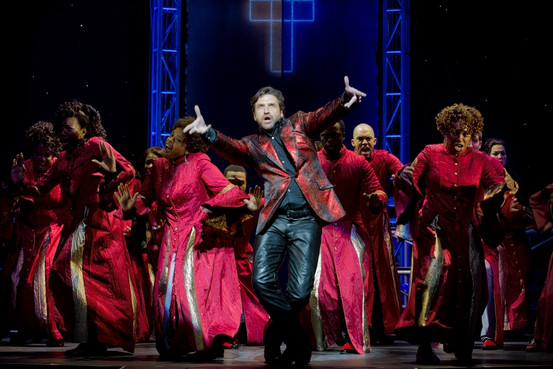
The cast includes Raúl Esparza (Jonas), Talon Ackerman (Jake), Krystal Joy Brown (Ornella), Kendra Kassebaum (Sam), Kecia Lewis-Evans (Ida Mae), Leslie Odom Jr. (Isaiah), and Jessica Phillips (Marla).

Ben Brantley (New York Times): Leap of Faith is this season’s black hole of musical comedy, sucking the energy out of anyone who gets near it. … Faith recycles its clichés without a shred of true conviction. Its jokes, its romantic scenes, its dance numbers, its interchangeable songs by Mr. Menken … all feel as if they had been pasted into place the night before. … [Esparza] at last comes into his own in the show’s penultimate number … in which he begs, “Give me something to believe in.” The audience has been silently asking the same thing for the previous two hours. But in Leap of Faith that prayer remains unanswered.

David Cole (Time Out): A show as bland and confused as Leap of Faith is not going to make rich men of its producers (among whom are actual church leaders). The fake cash distributed by actors to audience members – so we may place it in the offertory baskets at Jonas Nightingale’s revivalist hoedowns – is all the green this wanly tacky production is likely to see. … [It] never finds the right proportion of comic cynicism to wide-eyed spiritual wonder, foundering in a series of interchangeable song-and-dance numbers, tin-eared, mawkish dialogue and a generic gospel-country score that quickly evaporates from memory.

David Rooney (Hollywood Reporter): The stage musical improves on the original simply by settling on a point of view. But despite Raul Esparza’s hard-working lead performance and some rousing Gospel numbers from Alan Menken and Glenn Slater, the story remains stubbornly unappealing. … None of this is all that uplifting, but the actors give it their best shot. … None of it sounds terribly original or succeeds in covering for the shortage of emotional involvement. Ultimately, it’s hard to shake the feeling that despite all its singing to the Lord, Leap of Faith was never meant to be a musical.

Terry Teachout (Wall Street Journal): Raúl Esparza, the hardworking star, is smooth in the wrong way – he comes across like a talk-show host, not a sequin-spangled faith healer. … But if you’re looking for pure Broadway razzmatazz, Leap of Faith delivers the goods. … What Leap of Faith lacks are sweat and heart, the absence of which will be bothersome only if you permit yourself to imagine how this well-oiled applause machine might have run had its creators taken the plot seriously. … Not so the makers of Leap of Faith, who are, like Mr. Esparza, content to skate glamorously atop the surface of their characters’ feelings.

Linda Winer (Newsday): Esparza almost seems too smart – or perhaps just too grown-up – for the show. If so, this is hardly his fault. Despite the credentials of the creative team, the country/pop/gospel songs by Alan Menken and Glenn Slater (Sister Act) are repetitious and forgettable. … The crisis of faith in Kansas is awkwardly framed with a revival meeting on Broadway a year later. In these scenes, Esparza jokes with the audience. There are live TV monitors and characters in choir robes running up the aisle amid much lapping of elbows. It’s one thing for the plot to be about desperate, seedy people. But the show shouldn’t feel that way, too.

Posted in Broadway, Shows | Tagged , , , , , , , , | Leave a comment

The Internet Is For …

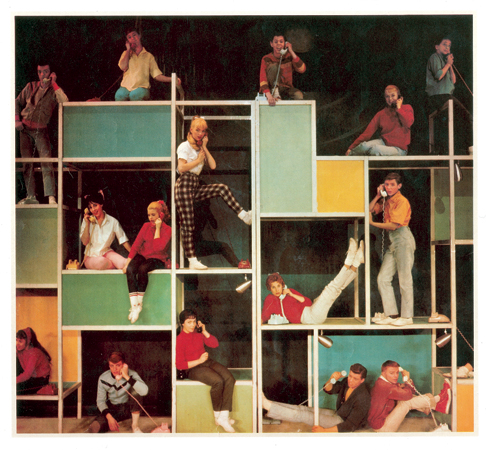
"Telephone Hour" from
Bye, Bye, Birdie

The past few days, Guardian theater bloggers have been buzzing once again about how (or if) theater can coexist with new media. On one side of the debate, Lyn Gardner believes you should “Switch on Your Phones,” warning theaters that don’t “embrace the interactive age.” On the other side, Matt Trueman wonders if by keeping our “Noises Off,” there isn’t a better way “to bring theater to an Internet audience.”

For example, Gardner was happy to see a family not just watching a live show but also “engaging it” – texting, tweeting, posting, camming – using those digital “extra layers and interactions and points of entry.” She writes, “Even if they are there in person, audiences don’t just want to consume passively, they want to interact with others also present, and to curate and document their own experience and give it shape and narrative.”

While Gardner talks about passiveness, Trueman talks about liveness. He writes, “Theater exists in two forms online. There’s theater as digital content – live broadcasts, online video and so on – and there’s digital content related to theater, like marketing or education tools.” The first form engages audiences collectively in shared time, the second individually in their own time. The first is more live than the second, but both do engage the audience, even if not as actively as Gardner wants.

And what she wants is digital content not only online but also, in effect, onstage – which may be a dangerous tipping point. As Jared Lanier wrote in his 2010 book, You Are Not a Gadget, “Giving yourself time and place to think and feel is crucial to your existence,” crucial to avoiding a “culture of reaction.” Lanier believes, “You have to be somebody before you can share yourself.” How can you shape a narrative, as Gardner hopes, if you don’t take the time to step back and review it? More to the point, how can you be meaningfully engaged, if you are never fully attentive?

Even though theater as digital content and digital content related to theater continue to proliferate, Gardner believes companies are still not “responsive to the desire of audiences to not just consume but to be engaged, to be heard and to be creative too. If theater can use the tools available to collaborate with audiences on that, then its future is assured.” I’m not so sure.

The rise of storefront nickelodeons a century ago drew audiences away from vaudeville, but it was economics not the new media that forced vaudeville houses to close. It became impossible to earn enough during the Depression to meet the weekly nut of salaries and maintenance. So, the current recession worries me more than the current technology does. When its palaces shuttered, vaudeville moved to post-war nightclub cabarets, then to mid-century TV variety shows, and now to Las Vegas extravaganzas. While the venues have changed, vaudeville has continued.

Just as film put pressure on vaudeville, it also put pressure on “legit” theater. In response, the Little Theater Movement blossomed, from the Pasadena Playhouse to the Provincetown Players. A generation later, La Mama and Caffe Cino gave rise to Off-Off-Broadway in basement boutiques and coffeehouses. Theater will continue, probably not in the cash-hungry McPACs designed to promote “cultural tourism” but in the Main Street storefronts decimated by Big Box stores. Theater will only die if it tries to be something it isn’t, if it disembodies itself, if it aims to become iStage.

Posted in Business, Producing | Tagged , , | Leave a comment